The Format of TIFF for Invoice ensures high-quality image preservation, making it ideal for detailed invoice documentation and archiving. TIFF files support multiple layers and pages, which allows for comprehensive invoice data to be stored in a single file without compression loss. This format is widely used in financial and administrative sectors due to its reliability and compatibility with various document management systems.
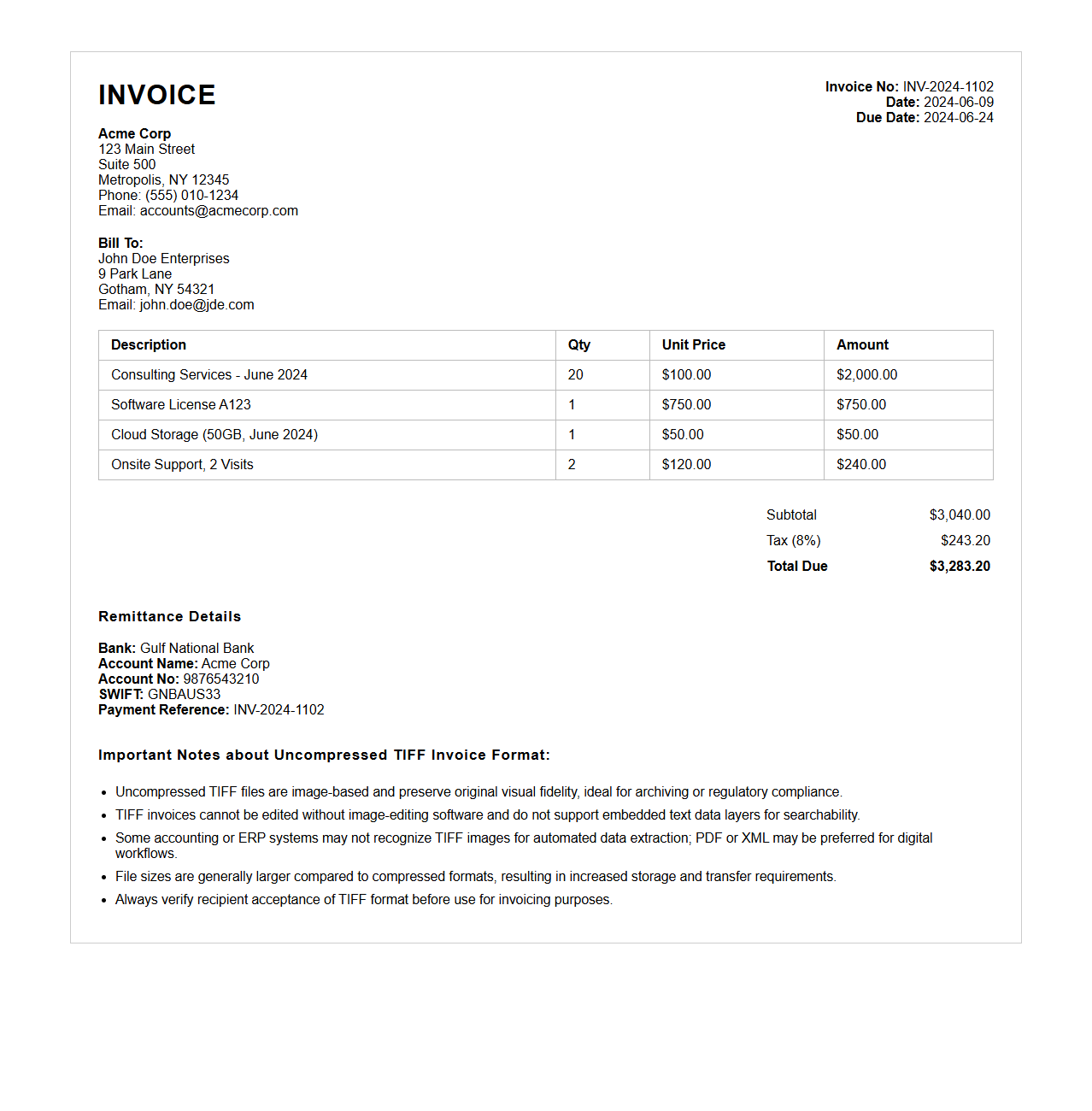
Uncompressed TIFF Invoice Format
An
Uncompressed TIFF Invoice Format document is a high-quality image file used for storing invoice data without any compression artifacts, ensuring the original details and clarity are preserved. This format is often utilized in industries where precise and clear documentation is critical for accounting and legal purposes. Its lossless nature guarantees that the invoice's visual integrity remains intact, facilitating accurate archiving and easy retrieval.
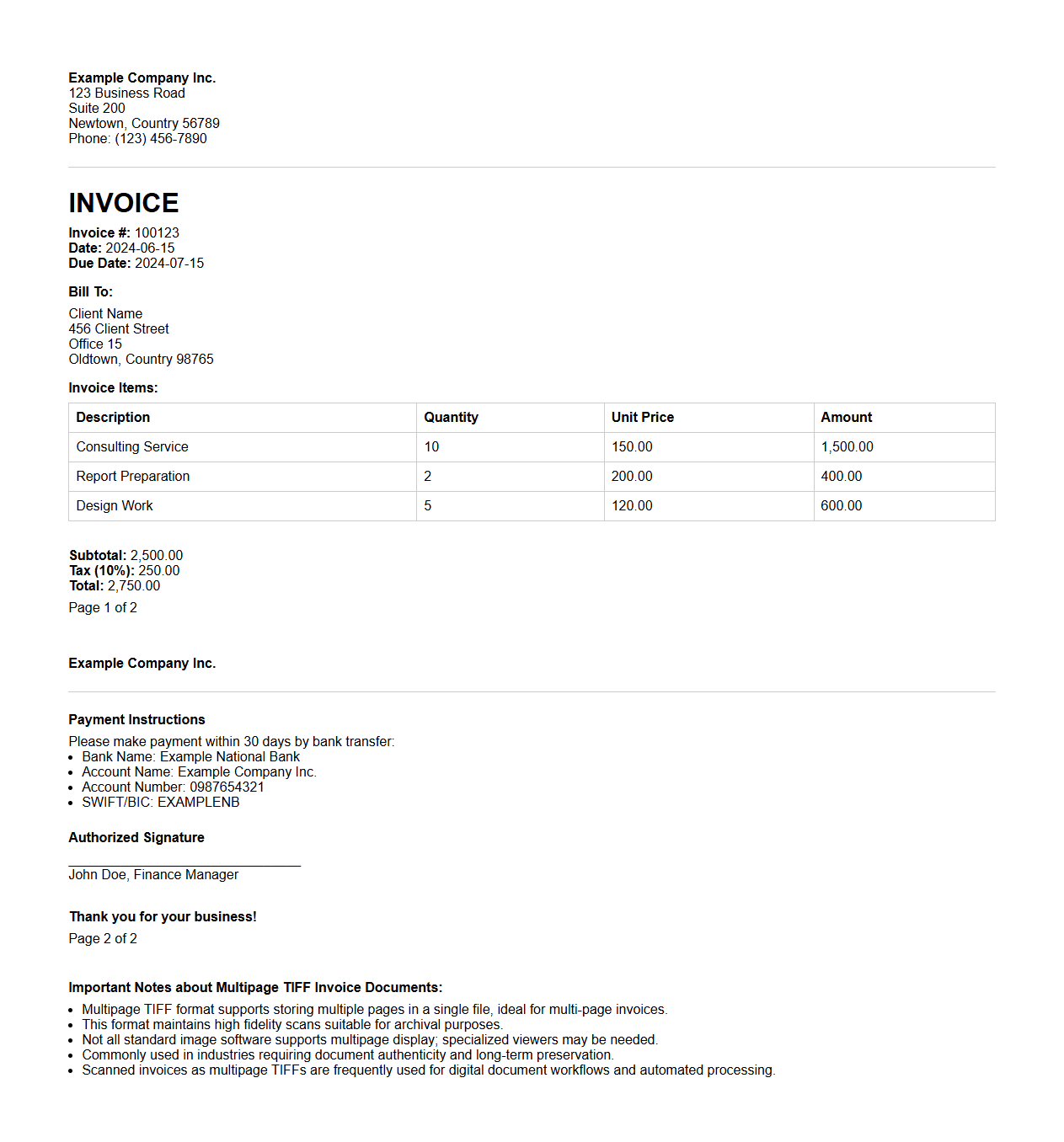
Multipage TIFF Invoice Document
A
Multipage TIFF Invoice Document is a digital file format that stores multiple invoice pages within a single Tagged Image File Format (TIFF) container. This format enables efficient organization, archiving, and retrieval of invoices by consolidating all invoice pages into one compact file. Multipage TIFFs are widely used in accounting and document management systems due to their high-quality image preservation and compatibility with various software applications.
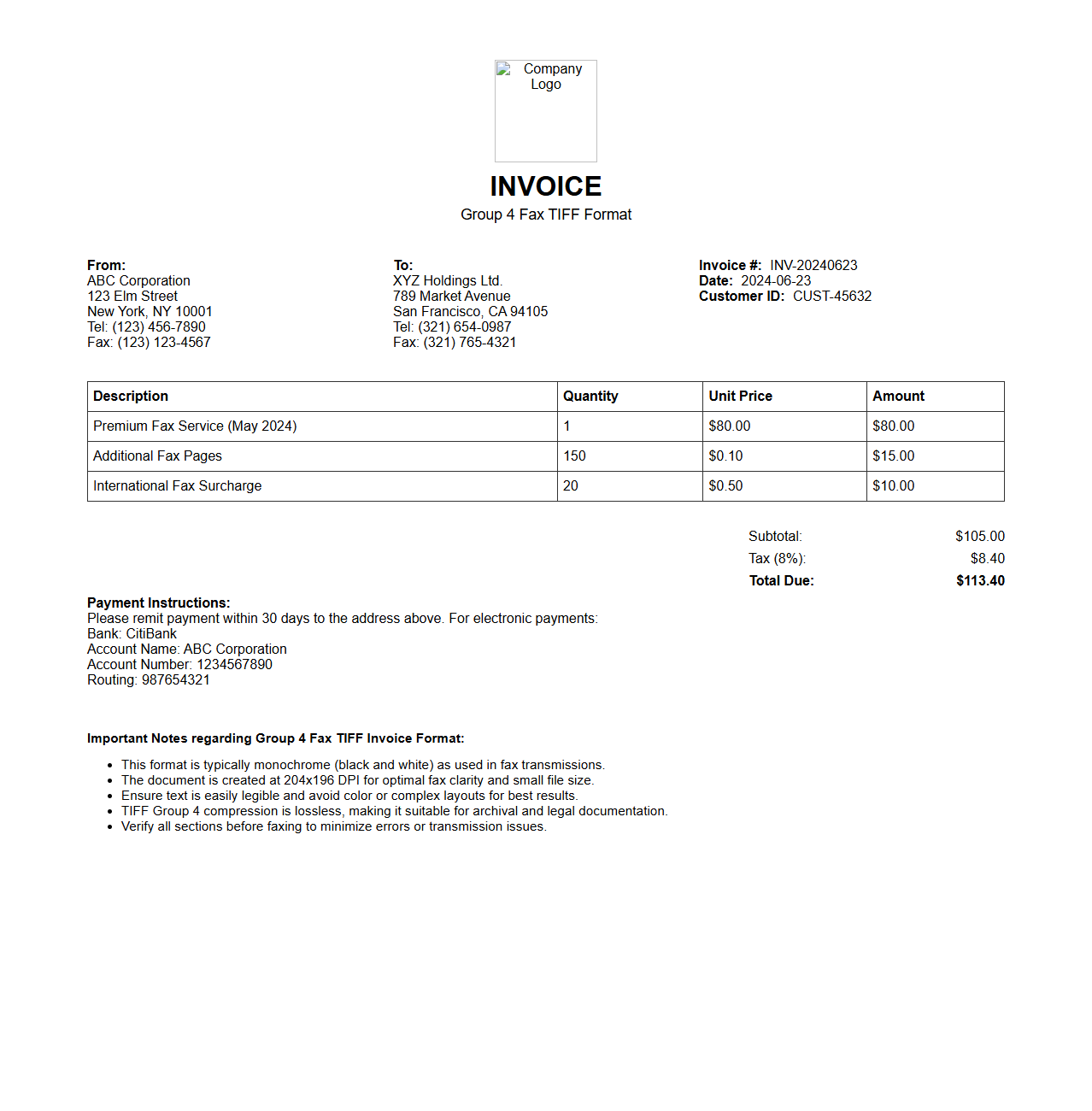
Group 4 Fax TIFF Invoice Format
Group 4 Fax TIFF Invoice Format is a widely used
document format designed for storing scanned invoices with high compression and lossless quality. This format utilizes Group 4 Fax encoding, optimizing black-and-white images ideal for fax transmissions and archival purposes. Its structure ensures clear readability of invoice details while minimizing file size for efficient storage and sharing.
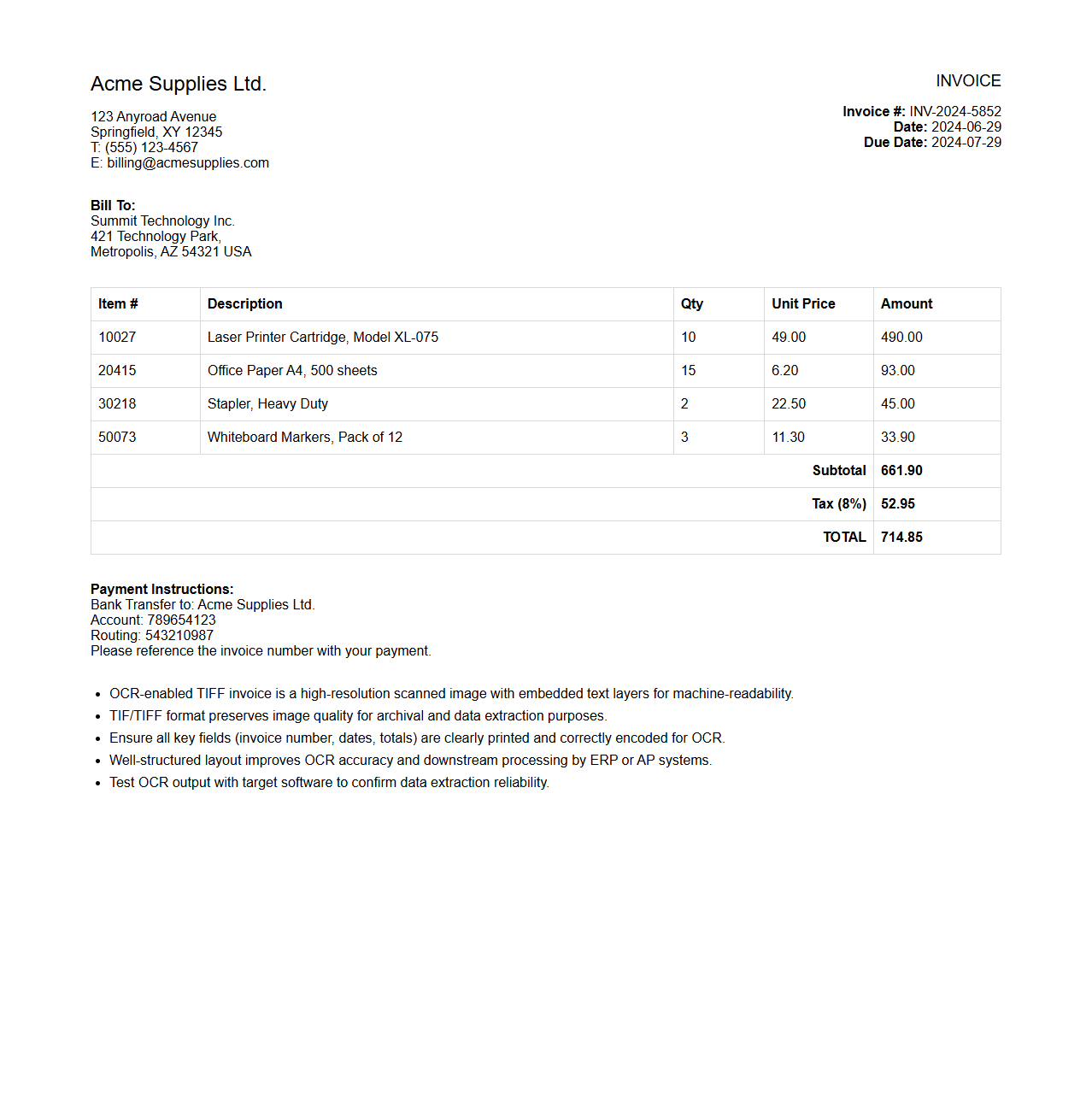
OCR-Enabled TIFF Invoice Format
OCR-Enabled TIFF Invoice Format document is a digital image file containing scanned invoice data, enhanced with Optical Character Recognition (OCR) technology that converts printed text into machine-readable content. This format allows automated extraction of invoice details such as vendor information, invoice numbers, dates, and amounts, streamlining accounts payable processes.
OCR-enabled TIFF invoices improve accuracy and efficiency in document management by enabling seamless data capture and integration with enterprise resource planning (ERP) systems.
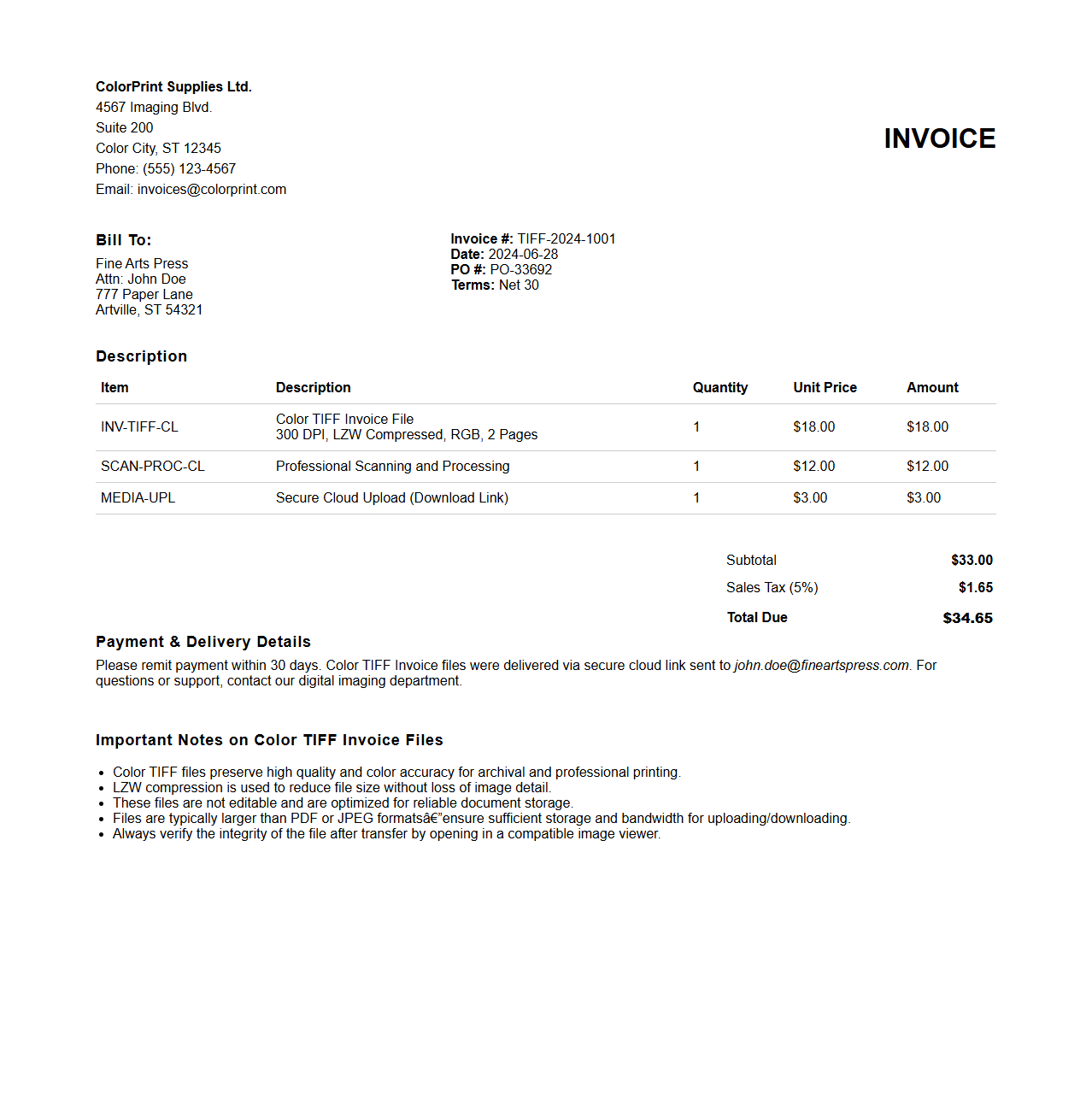
Color TIFF Invoice File
A
Color TIFF Invoice File is a digital document format that stores invoice images using Tagged Image File Format (TIFF) with color encoding. This format preserves the detailed visual appearance of invoices, including logos, signatures, and color-coded information, which helps in accurate record-keeping and verification. Color TIFF files are widely used in accounting and document management systems for their high-quality image retention and compatibility across various platforms.
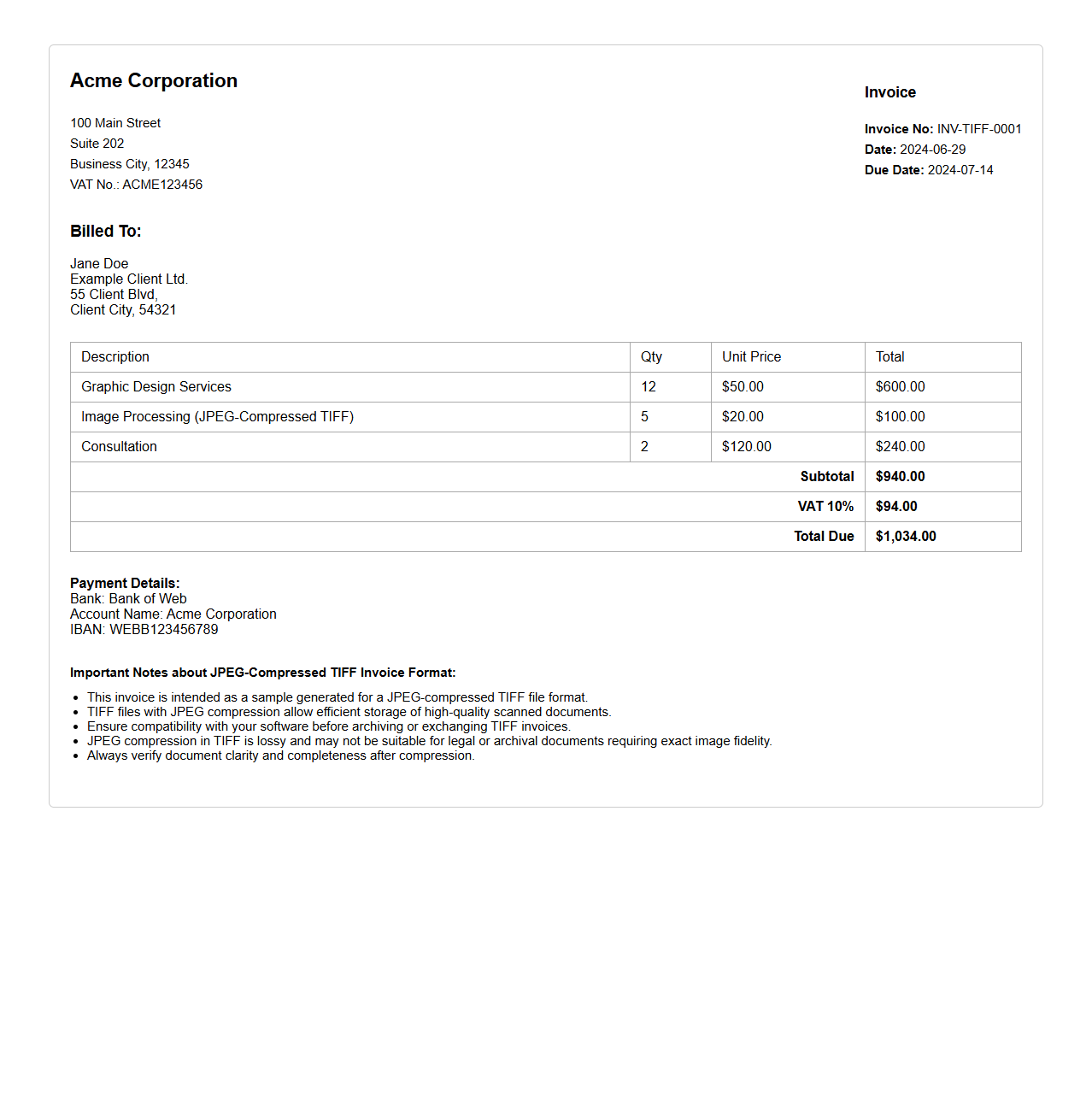
JPEG-Compressed TIFF Invoice Format
A
JPEG-Compressed TIFF Invoice Format document is a type of image file that combines the TIFF file format with JPEG compression to efficiently store scanned invoices. This format maintains high image quality while significantly reducing file size, making it ideal for archiving and transmitting business documents. It supports multi-page invoices, allowing multiple images or pages to be bundled into a single file, optimizing storage and retrieval processes.
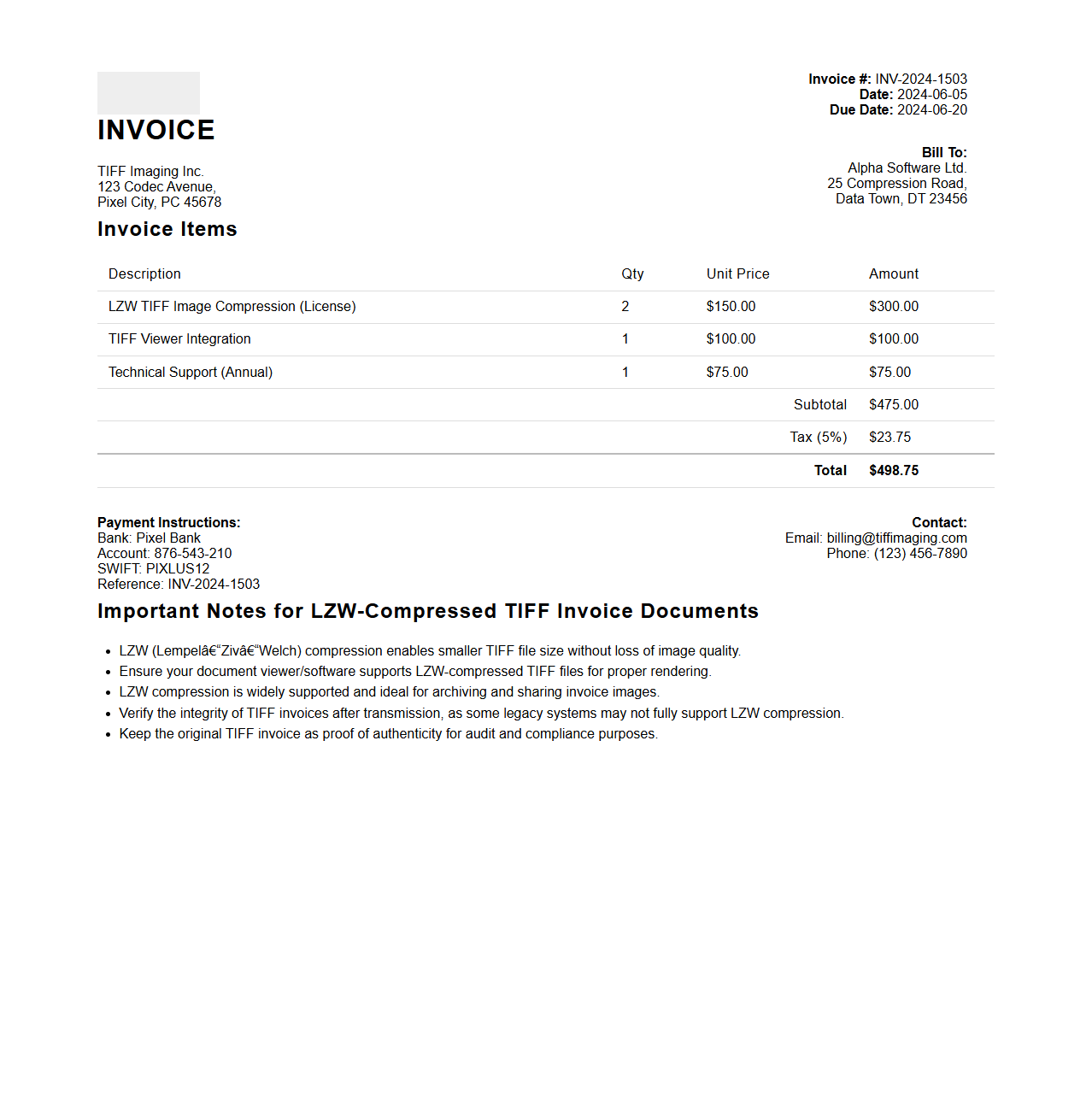
LZW-Compressed TIFF Invoice Document
LZW-Compressed TIFF Invoice Document is a type of digital file format that uses
LZW (Lempel-Ziv-Welch) compression to reduce the size of TIFF images, making storage and transmission more efficient. This format is commonly used for scanned invoice documents, preserving image quality while minimizing file size. Businesses rely on LZW-Compressed TIFF files for archiving and sharing invoices due to their compatibility and lossless compression method.
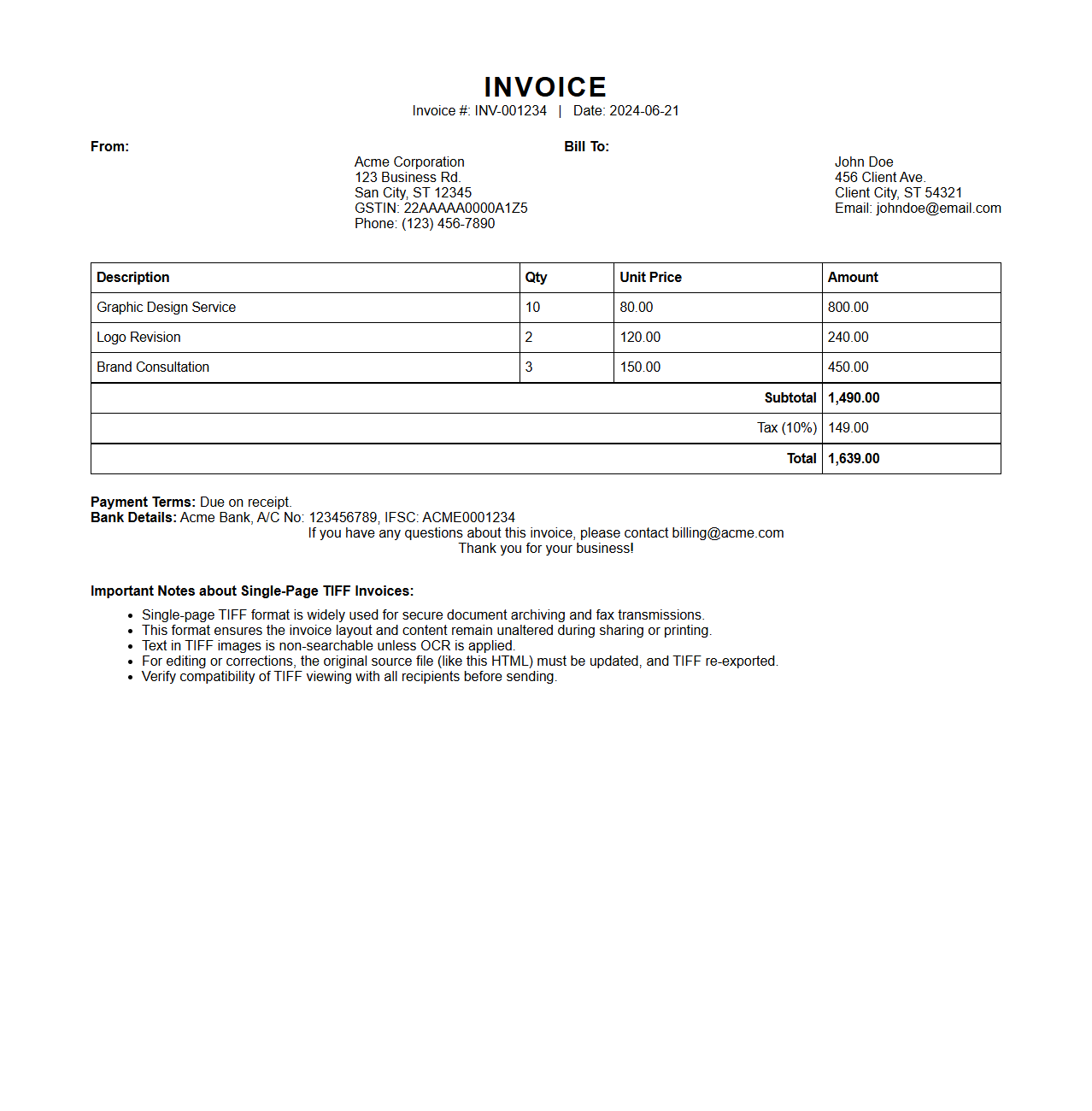
Single-Page TIFF Invoice Template
A
Single-Page TIFF Invoice Template is a digital document designed to generate invoices in the TIFF file format, containing all billing information on one page for easy viewing and printing. It ensures high-quality image resolution suitable for archiving and professional presentation in financial transactions. This template typically includes fields for company details, itemized charges, payment terms, and invoice numbers, streamlining accounts receivable processes.
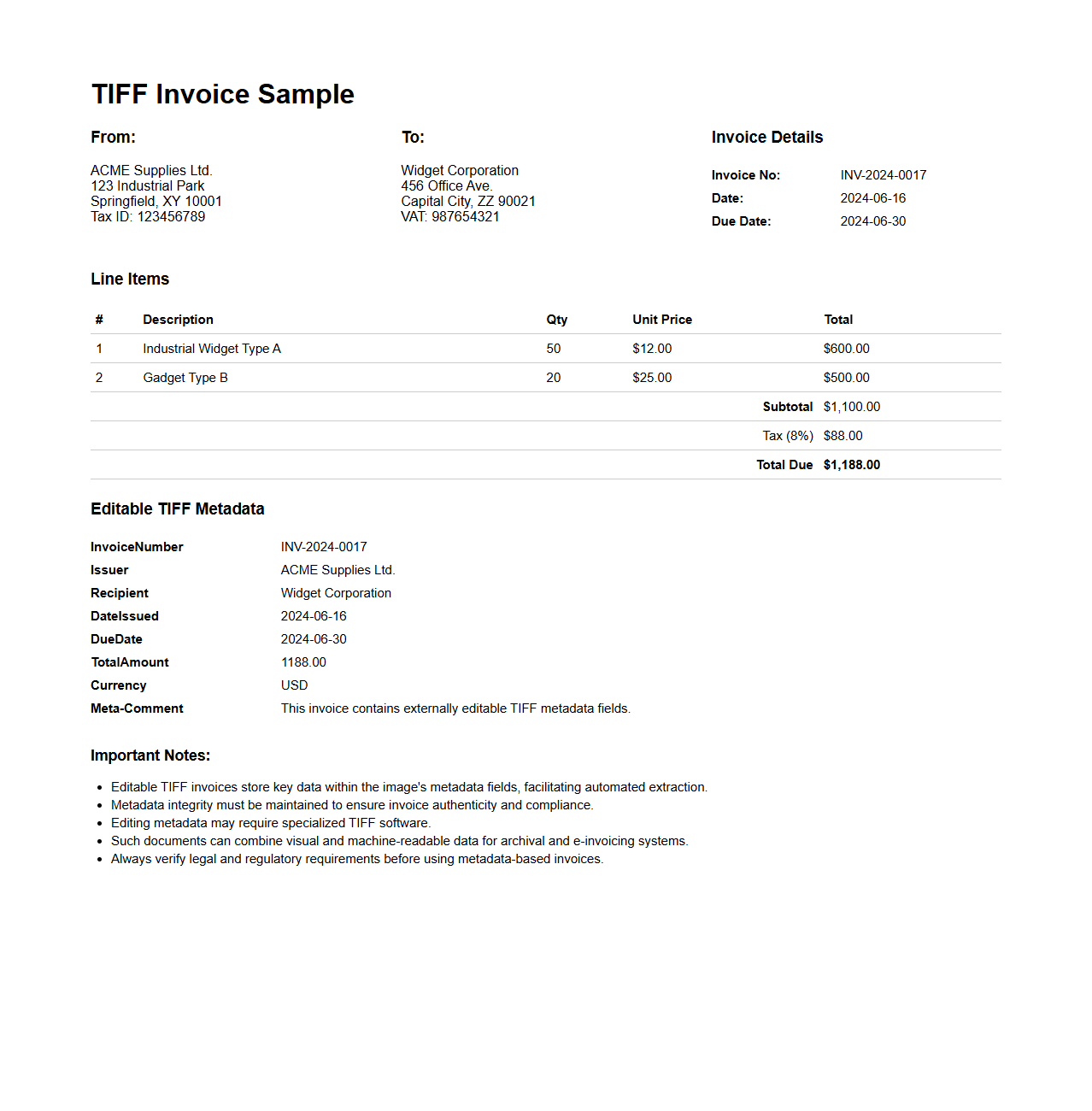
Editable Metadata TIFF Invoice
An
Editable Metadata TIFF Invoice document is a type of invoice file saved in Tagged Image File Format (TIFF) that allows users to modify embedded metadata without altering the visual image content. This metadata typically includes important information such as invoice number, date, vendor details, and payment terms, enabling efficient data extraction and automated processing in accounting systems. The editable nature of this metadata supports improved document management, compliance tracking, and streamlined financial workflows.
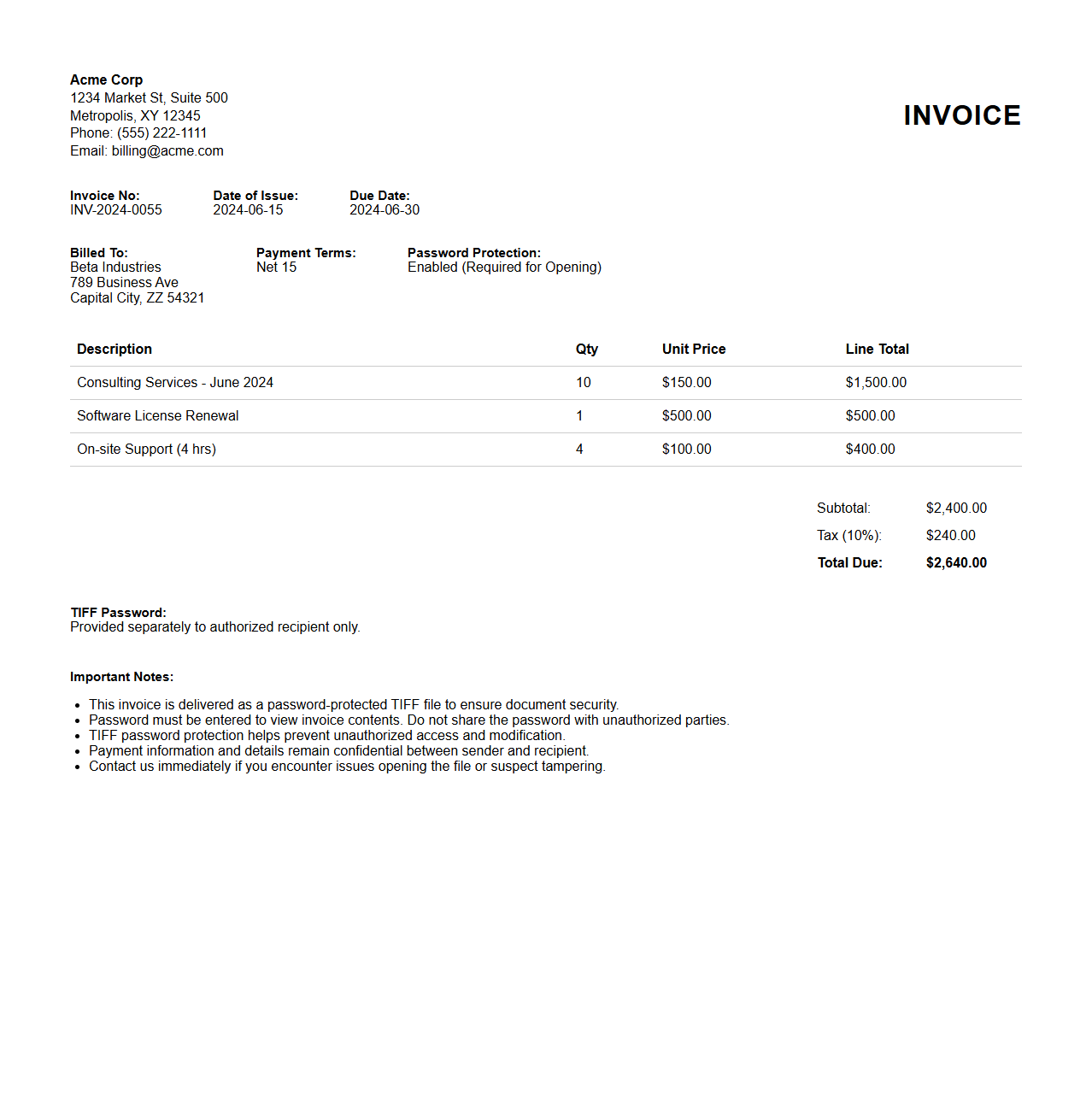
Password-Protected TIFF Invoice Format
A
Password-Protected TIFF Invoice Format document is a scanned invoice saved as a Tagged Image File Format (TIFF) file that requires a password to access its contents, ensuring enhanced security and restricted access. This format is commonly used in industries where sensitive financial data must be protected during digital storage and transmission. Encryption combined with TIFF's lossless compression preserves image quality while safeguarding important invoice information from unauthorized viewing or tampering.
How should metadata be embedded in TIFF invoice files for compliance?
Metadata in TIFF invoice files should be embedded using standard TIFF tags like ImageDescription and DocumentName to ensure compliance. It is essential to include invoice-related details such as invoice number, date, and vendor information within the metadata. Using XMP (Extensible Metadata Platform) can further enhance the metadata structure for better integration and accessibility.
What compression settings are optimal for invoice documents in TIFF format?
Optimal compression for TIFF invoices typically uses CCITT Group 4 (G4) compression, which is lossless and designed for monochrome images. This ensures high compression rates while preserving the integrity of text-based invoices. It is important to avoid lossy compression methods to maintain readability and compliance with archival standards.
Which TIFF tag conventions are standard for multi-page invoice images?
For multi-page invoices, the TIFF Directory (IFD) structure is used where each page is represented by a separate IFD. The PageNumber tag is commonly employed to identify the sequence of pages. Adhering to these conventions ensures seamless navigation and correct rendering of multi-page TIFF invoices.
How are digital signatures incorporated into TIFF invoices?
Digital signatures are typically embedded in TIFF invoices through metadata extensions or associated XML wrapper files. The signature data can be stored in custom TIFF tags or linked externally to maintain data integrity and authenticity. Implementing cryptographic techniques alongside TIFF metadata ensures secure verification of invoice provenance.
What color depth is recommended for scanned invoice TIFF files?
Scanned invoice TIFF files are best stored with a bitonal (1-bit) color depth to optimize file size without sacrificing clarity. This setting is ideal for text and line art commonly found on invoices, providing clear, sharp images. When color or grayscale is necessary, a grayscale (8-bit) depth is preferred to balance quality and storage efficiency.