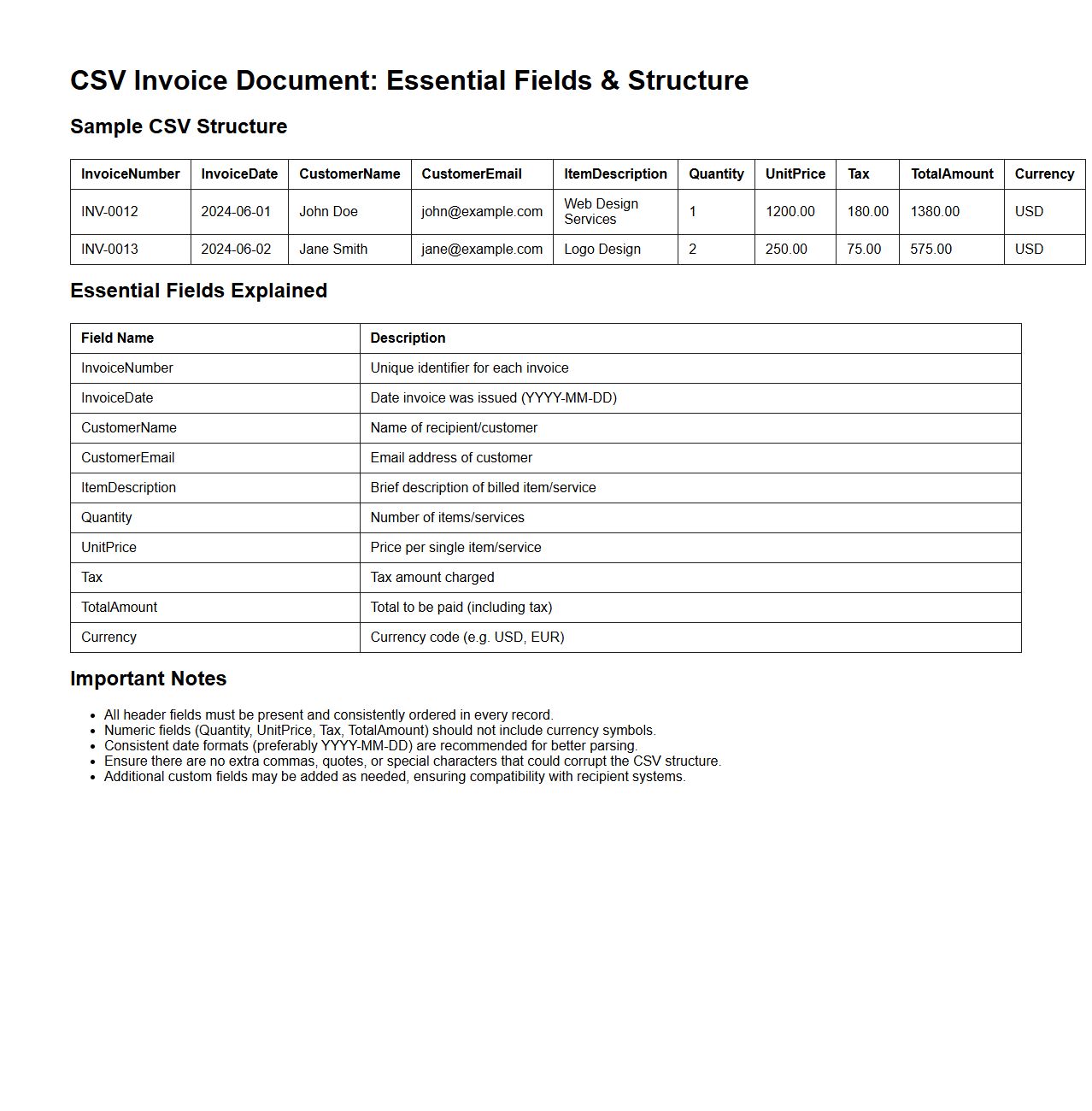
A CSV file for invoice typically contains structured data with columns representing key details such as invoice number, date, customer name, item description, quantity, price, and total amount. Each row corresponds to a single invoice record, making it easy to import and process in accounting software. Correct formatting ensures accurate data extraction and seamless integration with financial systems.
Essential Fields and Structure of a CSV Invoice Document
A CSV invoice document contains
essential fields such as invoice number, date, customer details, item descriptions, quantities, unit prices, and total amounts to ensure accurate billing and record-keeping. The structure organizes these fields into rows and columns, allowing for easy parsing and integration with accounting software. Proper formatting and consistent data entry within this tabular format facilitate efficient invoice processing and reduce errors.
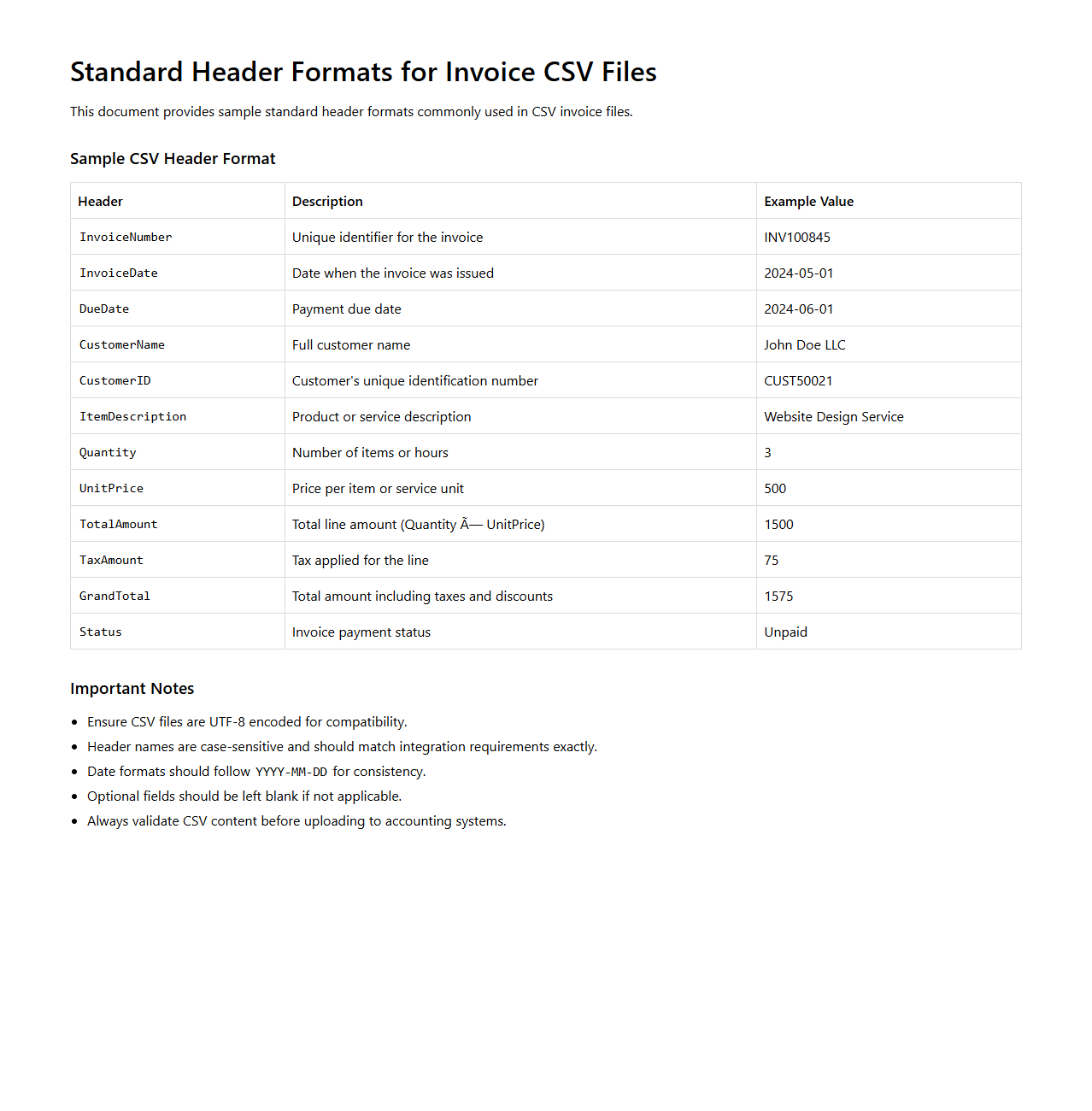
Standard Header Formats for Invoice CSV Files
The
Standard Header Formats for Invoice CSV Files document defines the required structure and naming conventions for column headers in CSV files used for invoicing purposes. This standardization ensures consistent data interpretation across different accounting systems and facilitates seamless data import and export. Adhering to these header formats minimizes errors and improves the efficiency of invoice processing workflows.
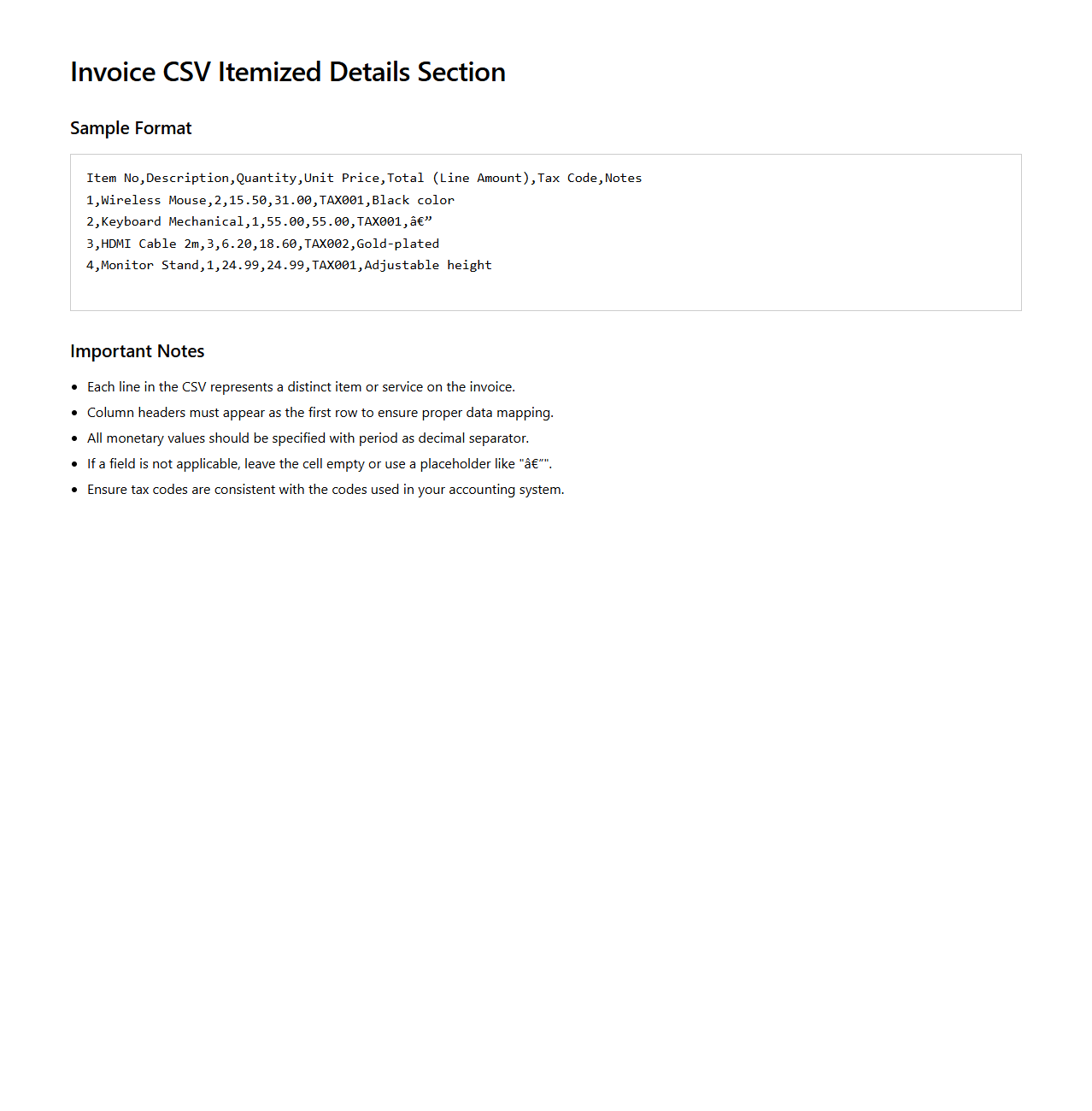
Itemized Details Section in Invoice CSV Document Format
The
Itemized Details Section in an Invoice CSV Document Format provides a structured breakdown of products or services listed in the invoice, including fields such as item description, quantity, unit price, and total amount. This section enables clear tracking of each charge, ensuring transparency and accuracy in billing and accounting processes. Detailed itemization facilitates easier data extraction and integration with financial software for automated processing and reporting.
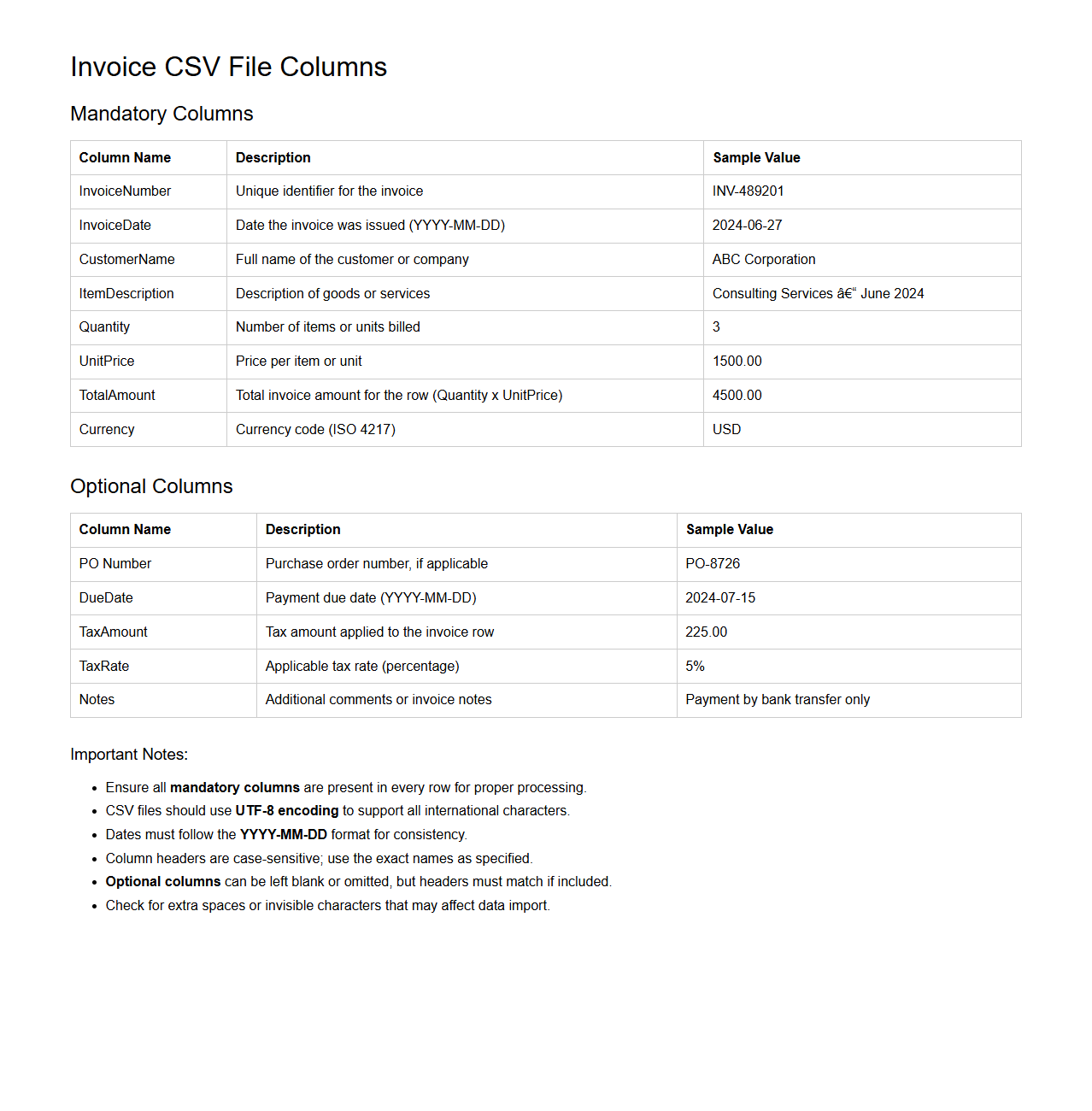
Mandatory and Optional Columns in Invoice CSV Files
Mandatory columns in an invoice CSV file are essential data fields required for accurate processing, including invoice number, date, customer ID, and total amount, ensuring compliance and system integration. Optional columns provide supplementary information such as discount details, tax codes, or purchase order numbers, which enhance record completeness but are not critical for basic invoice validation. Defining these columns clearly within the document helps standardize data entry and supports efficient invoice management workflows.
Customer and Vendor Data Fields in Invoice CSV Templates
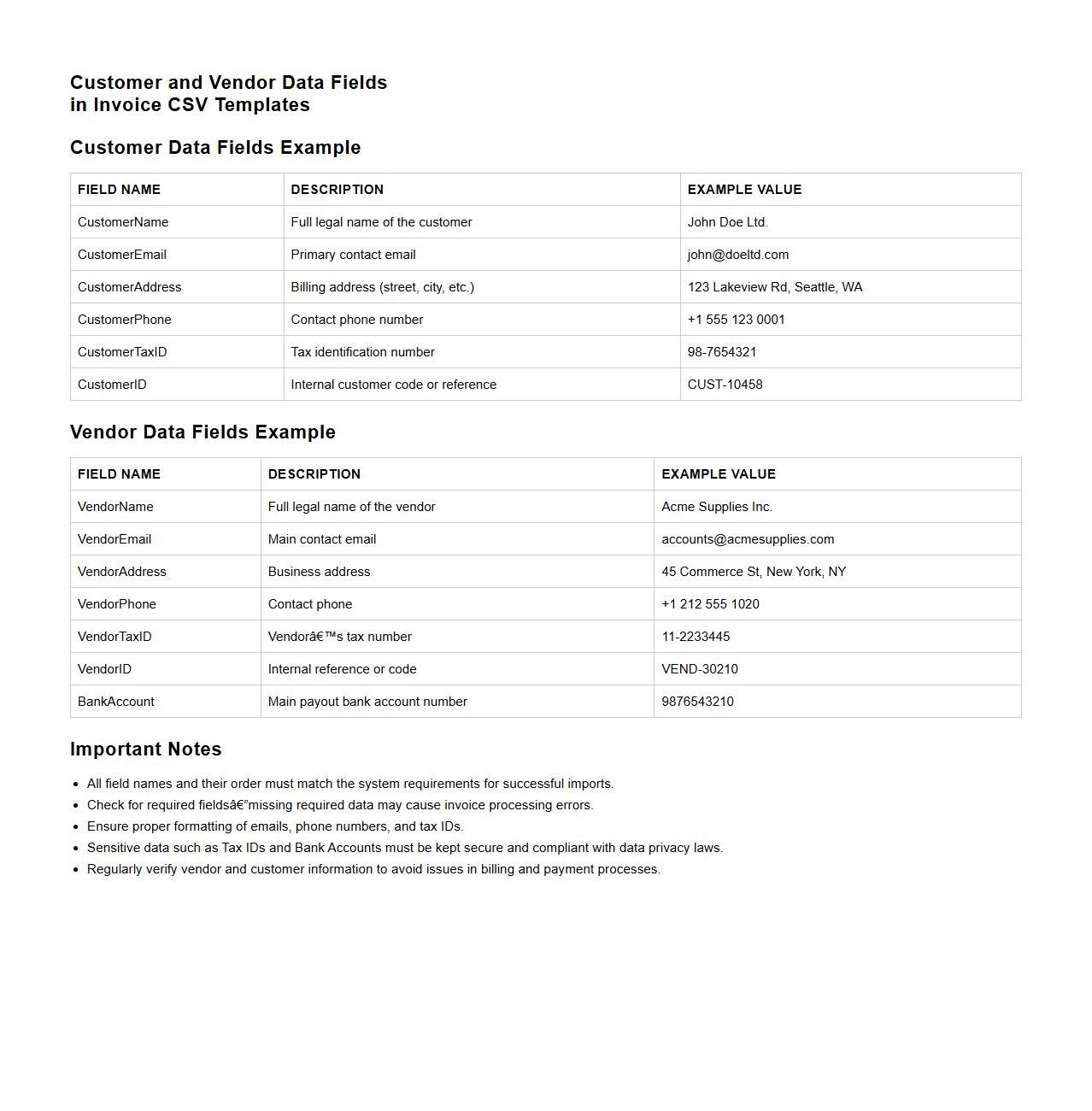
Customer and Vendor Data Fields in Invoice CSV Templates document encompass essential information such as names, addresses, contact details, tax identification numbers, and payment terms. These fields ensure accurate identification and seamless processing of invoices between businesses, facilitating financial record keeping and compliance. Properly structured
Customer and Vendor Data Fields enable efficient data integration with accounting and ERP systems.
Payment Terms and Conditions in Invoice CSV Structure
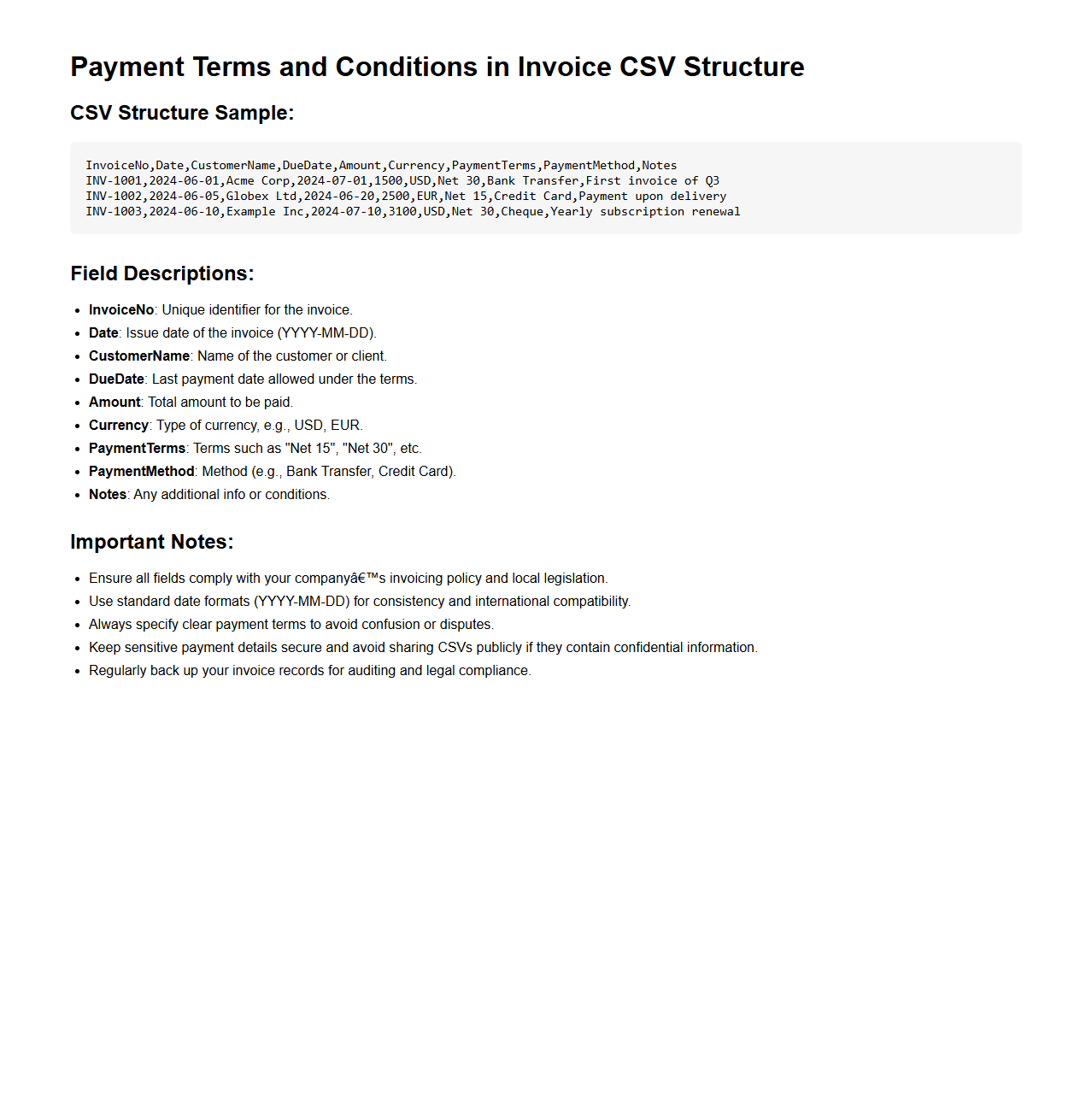
Payment Terms and Conditions in an Invoice CSV Structure document define the specific agreements regarding the timing and methods of payment between the buyer and seller. These terms typically include due dates, discount options for early payment, late payment penalties, and accepted payment methods, all essential for ensuring clear financial expectations. Clearly specifying
Payment Terms and Conditions helps prevent disputes and facilitates smooth transaction processing within automated invoicing systems.
Tax and Discount Representation in Invoice CSV Format
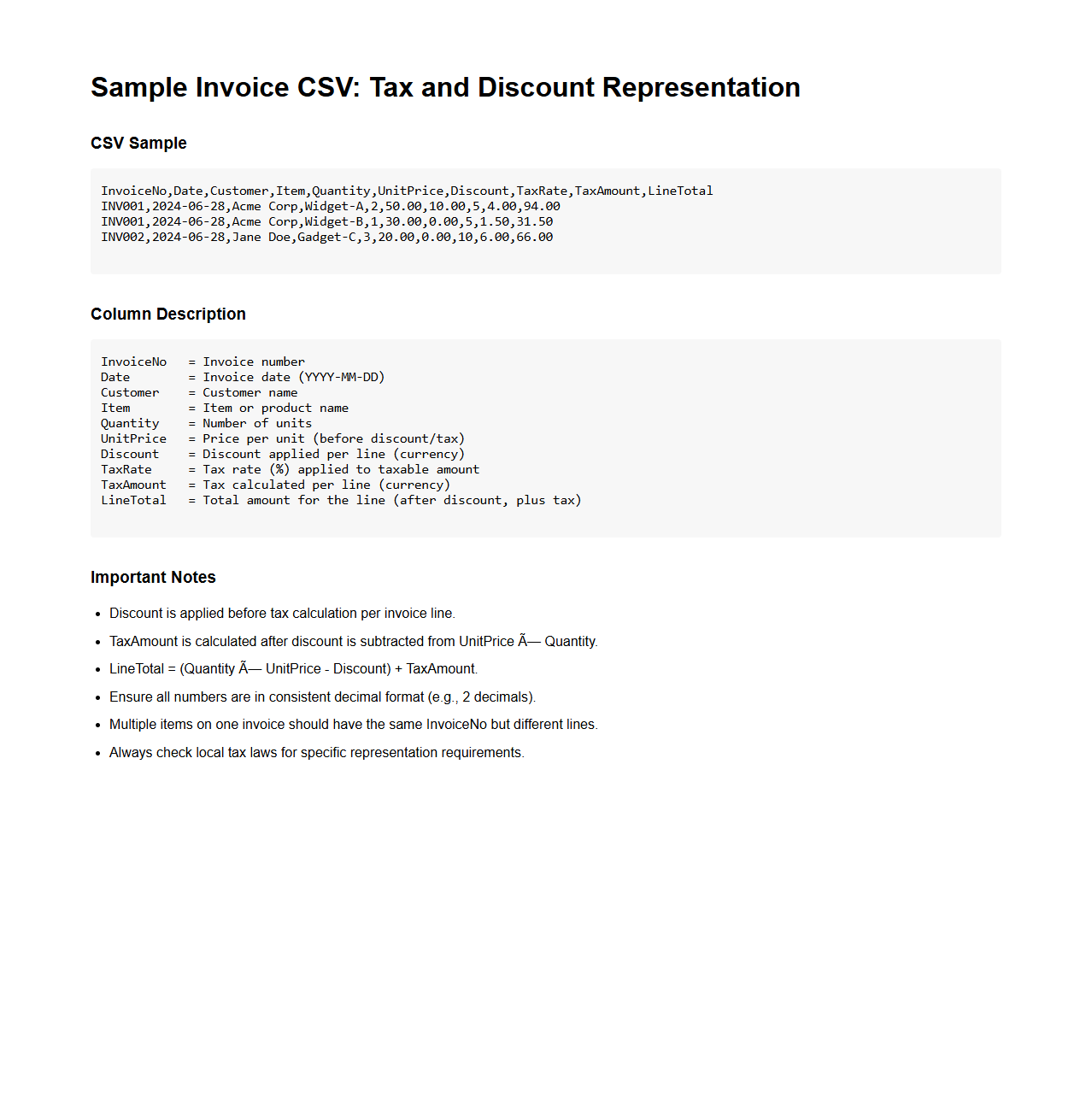
Tax and Discount Representation in an Invoice CSV format document involves specifying detailed fields for applicable taxes and discounts on each line item or the entire invoice. These fields typically include tax rates, tax amounts, discount rates, and discount amounts, ensuring clarity in financial calculations and compliance with tax regulations. Proper representation enables accurate accounting, reporting, and automation of invoice processing systems.
Date and Number Formatting Guidelines for Invoice CSV
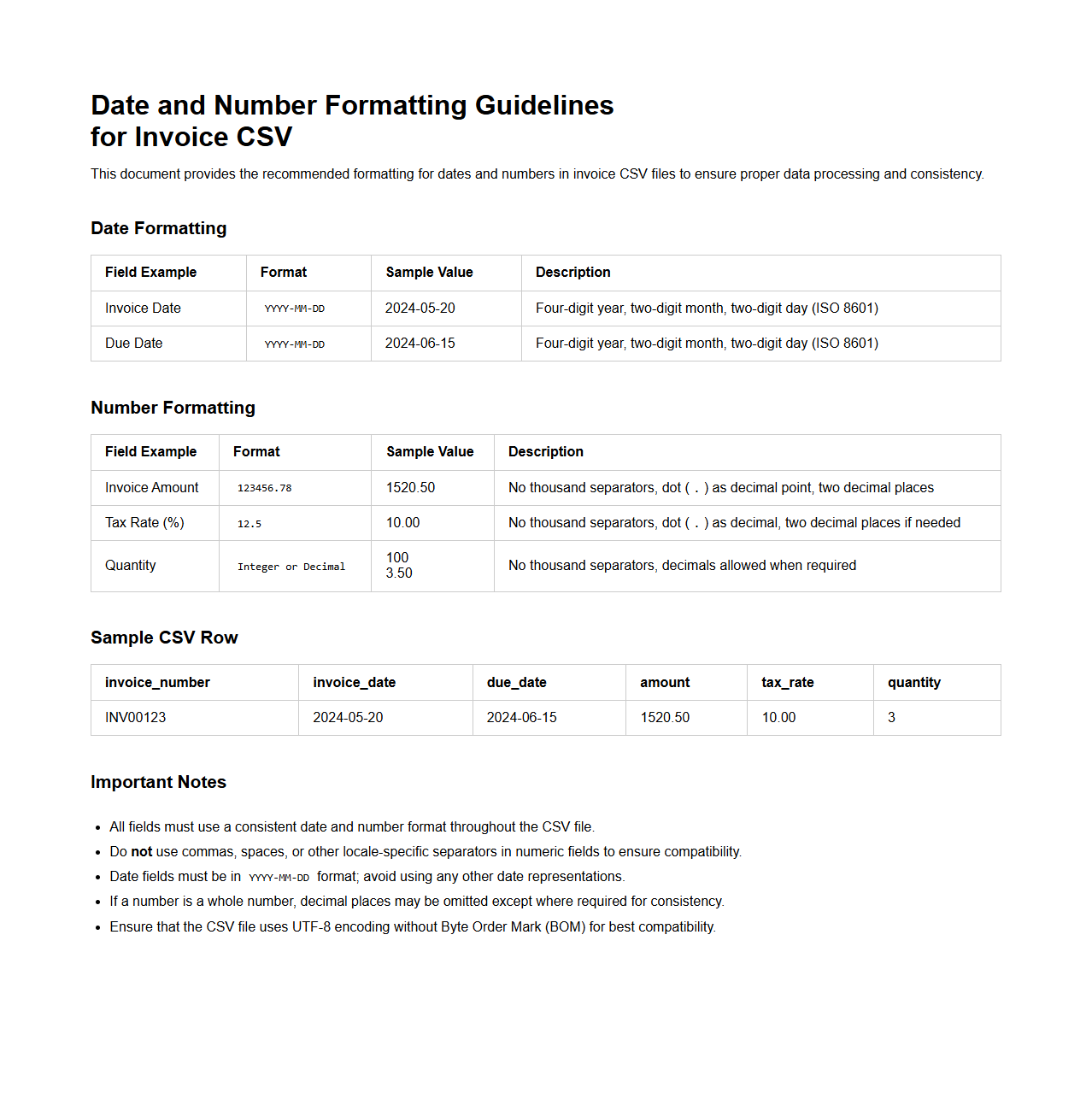
Date and Number Formatting Guidelines for Invoice CSV documents ensure that all dates are presented in a consistent format, typically ISO 8601 (YYYY-MM-DD), to avoid ambiguity across different regional settings. Numeric values, especially monetary amounts, must use a standardized decimal separator (usually a period) and avoid thousands separators to facilitate accurate parsing and calculations. Adhering to these guidelines is crucial for seamless data import and processing in accounting software and financial systems.
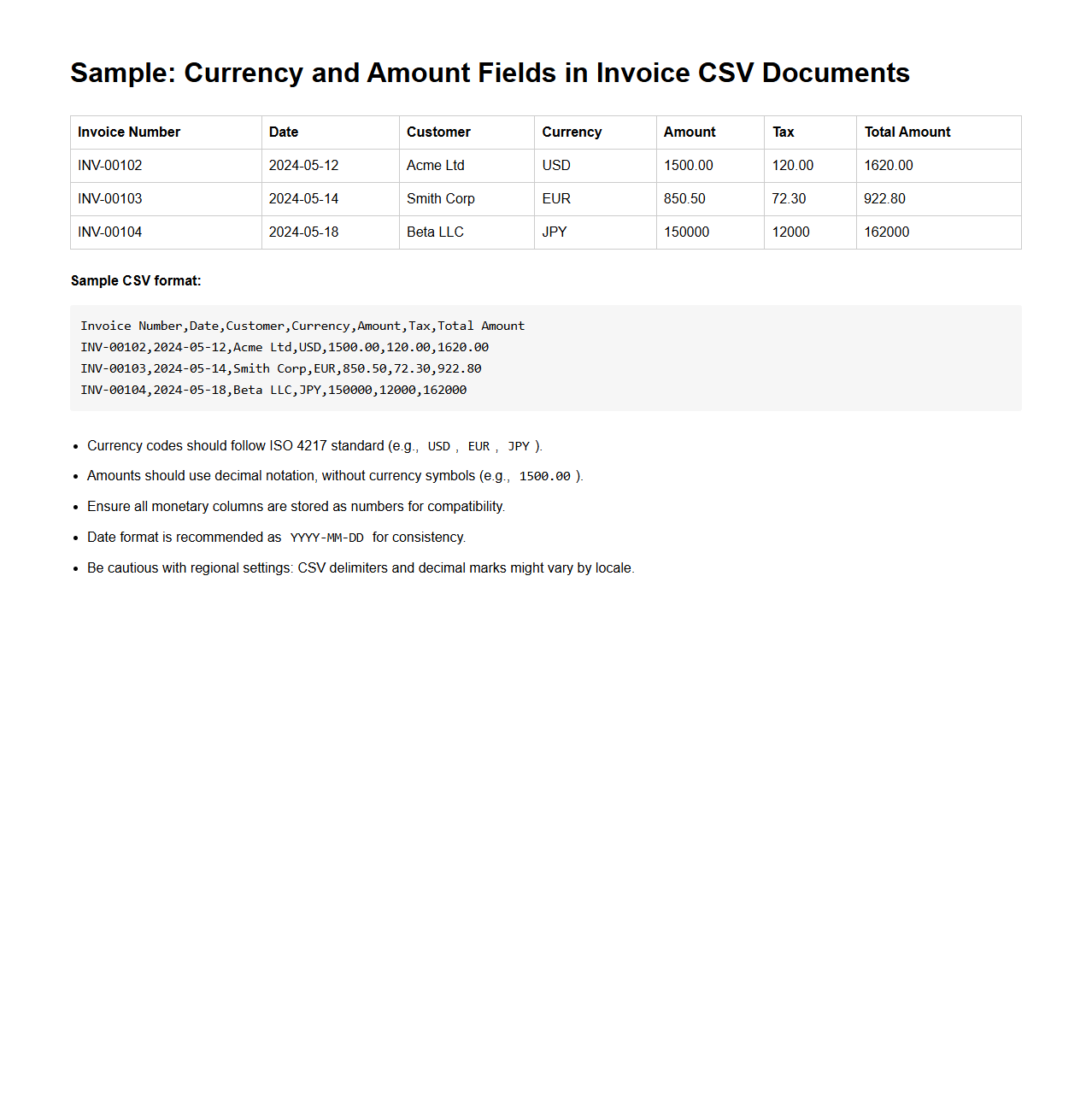
Currency and Amount Fields in Invoice CSV Documents
Currency and Amount Fields in Invoice CSV documents are essential for accurately representing the financial details of transactions. The Currency field specifies the type of currency used, such as USD or EUR, ensuring clarity in international or multi-currency invoicing. The Amount field denotes the numerical value associated with each transaction line, enabling precise calculations and financial reporting.
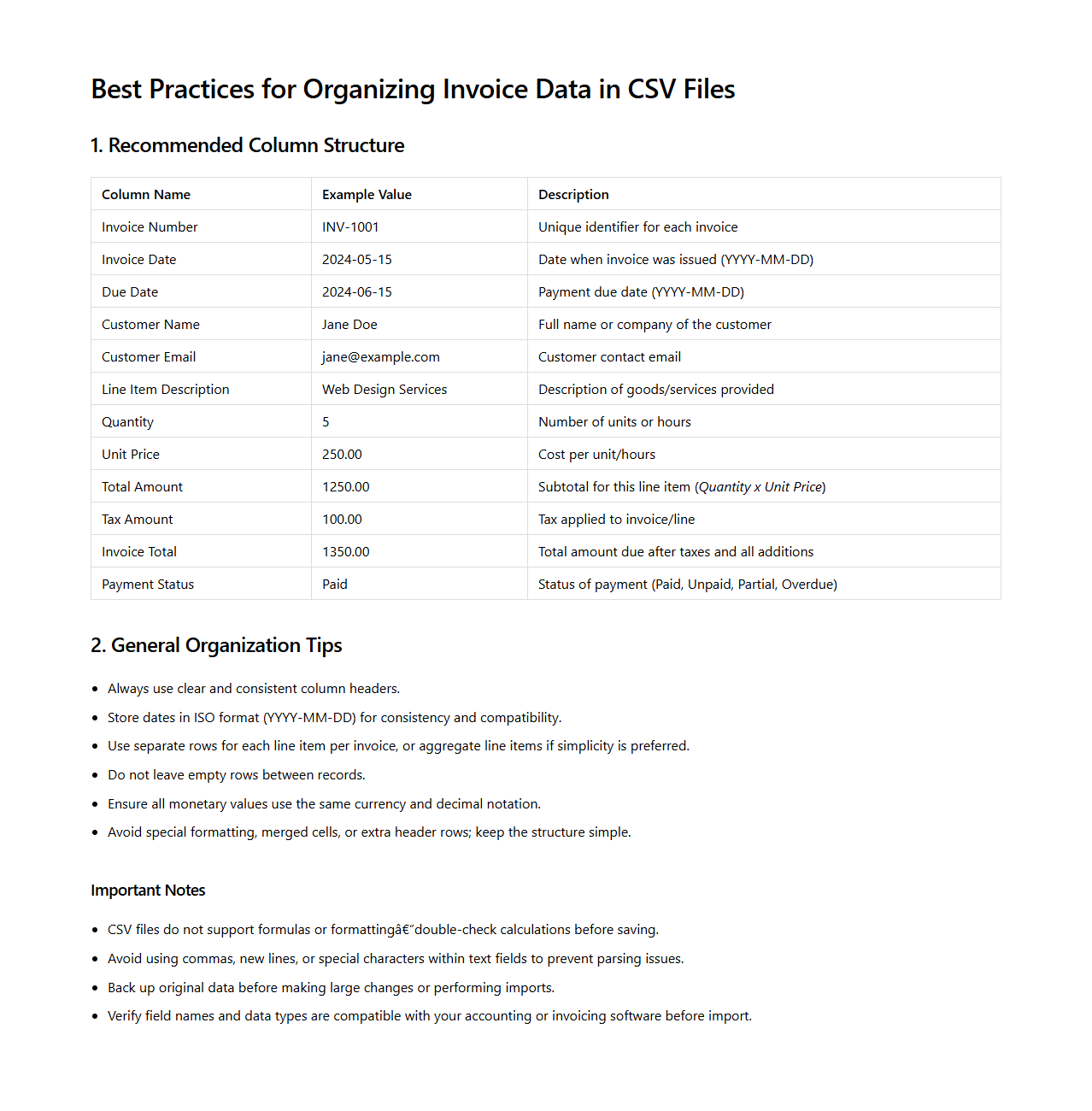
Best Practices for Organizing Invoice Data in CSV Files
The
Best Practices for Organizing Invoice Data in CSV Files document provides guidelines to ensure accurate, consistent, and efficient management of invoice information. It emphasizes standardized column headers, consistent data formats for dates and currency, and the inclusion of essential fields such as invoice number, client details, item descriptions, quantities, and total amounts. Proper organization facilitates seamless data import into accounting software, improves data analysis accuracy, and minimizes errors during financial reporting.
What are the mandatory columns in a CSV file for invoice processing?
The mandatory columns in a CSV file for invoice processing typically include Invoice Number, Invoice Date, Customer Name, Item Description, Quantity, Unit Price, and Total Amount. These columns ensure that the invoice can be accurately tracked and processed by the accounting system. Omitting any essential column could lead to errors or incomplete invoice processing.
How should date fields be formatted in a CSV invoice file?
Date fields in a CSV invoice file should follow the ISO 8601 format (YYYY-MM-DD) to ensure consistency and easy parsing across different software systems. Using a standardized date format helps prevent misinterpretation due to regional date differences. Avoid ambiguous formats like MM/DD/YYYY or DD/MM/YYYY which can create confusion.
What delimiter is recommended for international invoice CSVs?
The recommended delimiter for international invoice CSVs is the comma (,), as it is the most widely supported delimiter across various spreadsheet and accounting software globally. However, in regions where comma is used as a decimal separator, the semicolon (;) is sometimes preferred. It is important to check local conventions and ensure the delimiter is consistent throughout the file.
How to handle multi-line address fields in a CSV invoice document?
To handle multi-line address fields in a CSV invoice document, enclose the entire address in double quotes to preserve line breaks and commas within the address. This prevents the CSV parser from incorrectly splitting the field into multiple columns. Maintaining the integrity of the address field is crucial for accurate billing and shipping information.
Are currency symbols included in the CSV amount columns for invoices?
Currency symbols should generally not be included within the amount columns of a CSV invoice file to avoid parsing errors and ensure numeric data consistency. Instead, use a separate column to specify the currency code (e.g., USD, EUR). This approach facilitates easier data processing and currency conversions by accounting systems.