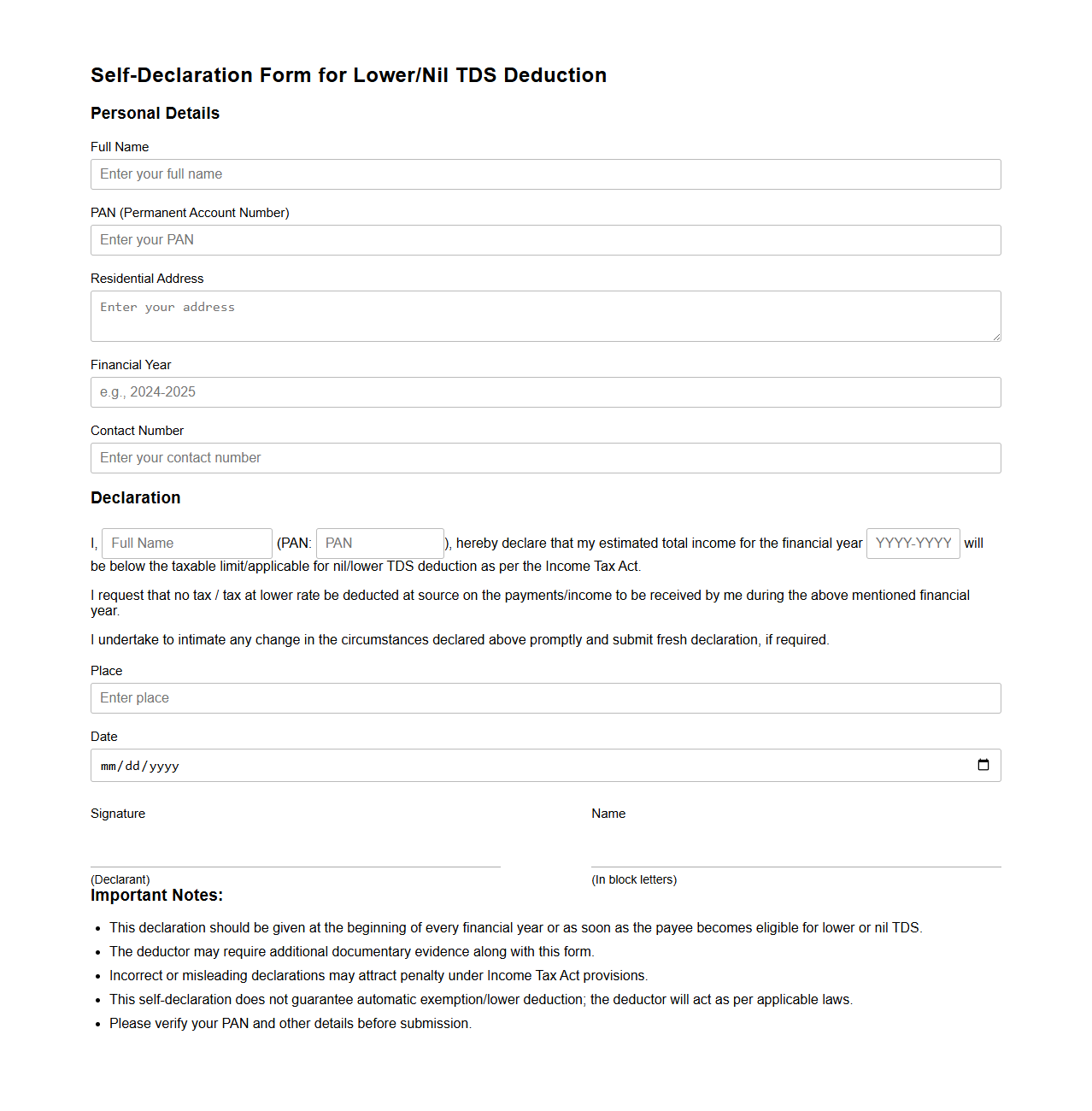
The Format of Self-Declaration Form for Lower/Nil TDS includes essential details such as the taxpayer's name, PAN, and the reason for claiming lower or nil TDS. It requires the declaration to be signed and dated, confirming the accuracy of the information provided. This format ensures compliance with tax regulations while enabling the deductor to apply the correct TDS rate.
Basic Self-Declaration Form for Lower/Nil TDS Format
A
Basic Self-Declaration Form for Lower/Nil TDS is a document used by taxpayers to declare their eligibility for availing a reduced or nil Tax Deducted at Source (TDS) rate as per income tax provisions. This form contains essential details like PAN, income particulars, and relevant tax sections to certify that the taxpayer's income does not warrant higher TDS deduction. Submitting this form helps deductors apply the correct TDS rate, preventing excessive tax withholding and easing tax compliance.
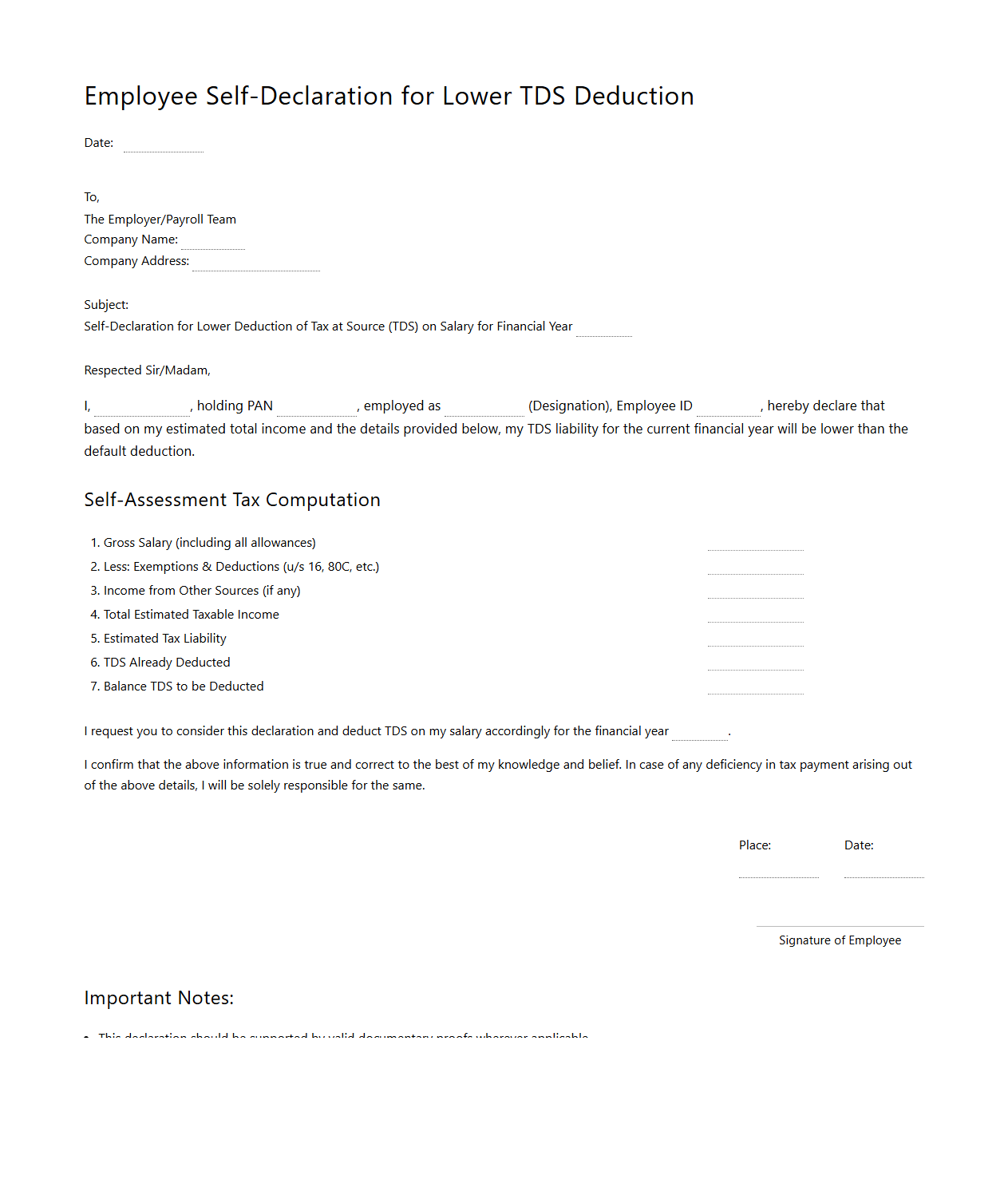
Employee Self-Declaration for Lower TDS Deduction Format
Employee Self-Declaration for Lower TDS Deduction Format is a formal document submitted by employees to their employers, requesting a reduction in the tax deducted at source (TDS) on their salary income. This declaration includes details such as estimated income, investments, and eligible deductions under the Income Tax Act, enabling employers to calculate TDS more accurately. The use of a
self-declaration form helps employees avoid excess tax deduction and ensures compliance with tax regulations.
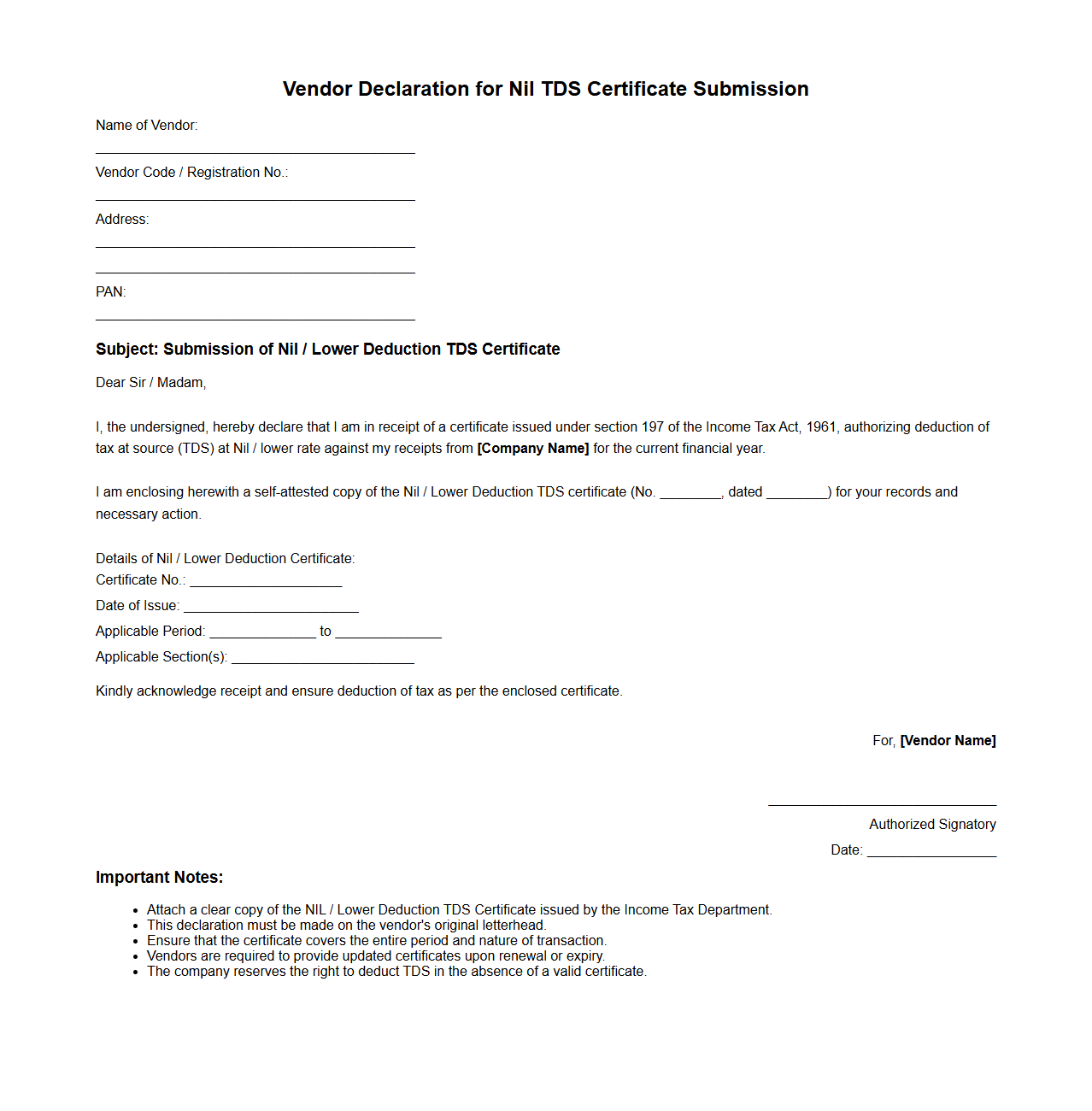
Vendor Declaration Format for Nil TDS Certificate Submission
Vendor Declaration Format for Nil TDS Certificate Submission is a standardized document that vendors use to declare their income status to the deductor, ensuring that no Tax Deducted at Source (TDS) should be applied on payments made to them. This declaration typically includes important details such as the vendor's PAN, Tax Identification Number (TIN), business nature, and a certification statement affirming exemption from TDS as per prevailing income tax regulations. The
Nil TDS Certificate helps streamline financial transactions by preventing unnecessary tax deductions and complying with the Income Tax Department's requirements.
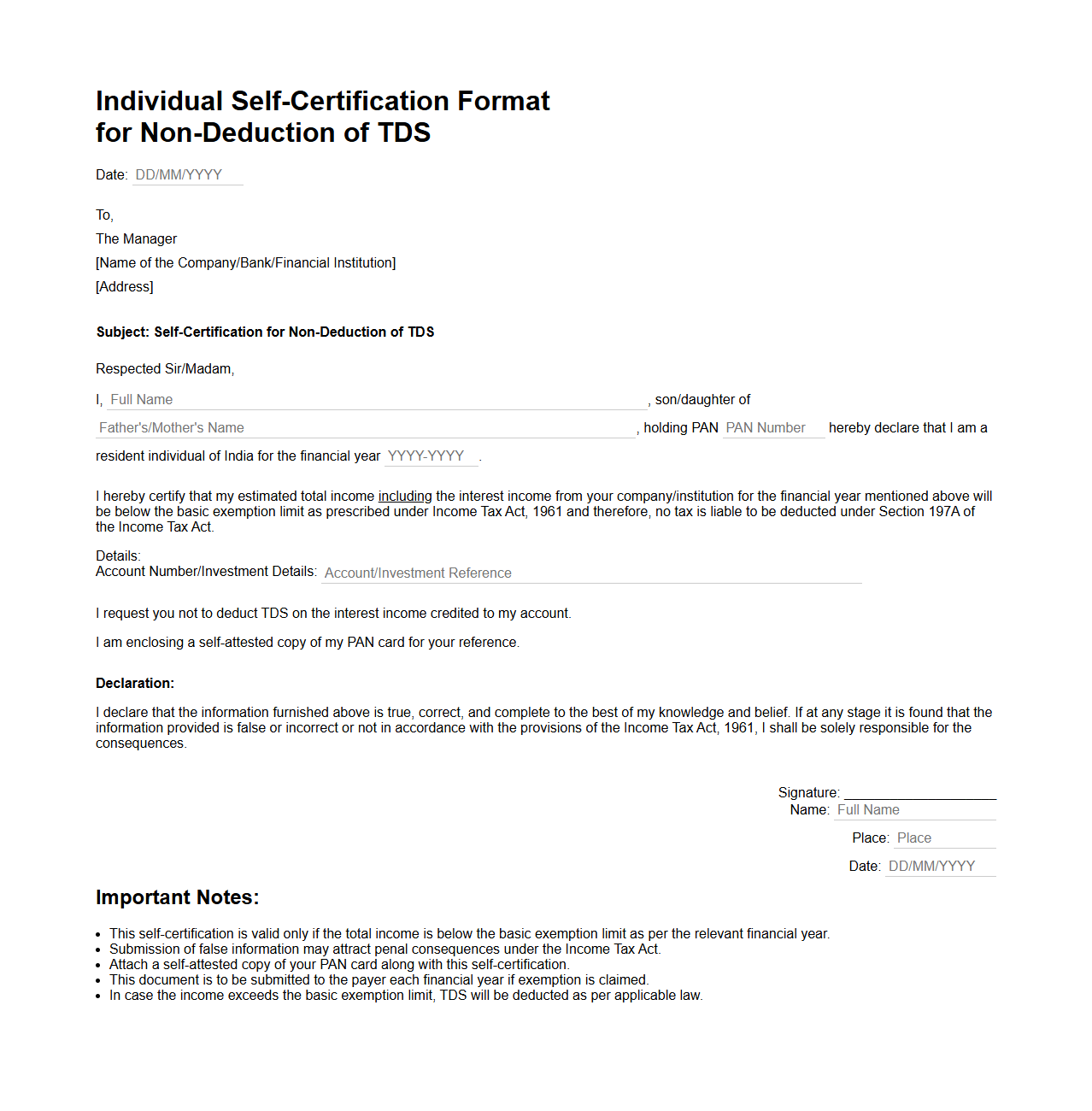
Individual Self-Certification Format for Non-Deduction of TDS
The
Individual Self-Certification Format for Non-Deduction of TDS is a document used by individuals to declare their eligibility for exemption from Tax Deducted at Source (TDS) on certain incomes. This format helps financial institutions or deductors verify that the individual meets specific conditions under the Income Tax Act, ensuring that TDS is not applied incorrectly. The self-certification typically includes personal details, a declaration of income status, and relevant tax exemption clauses supporting non-deduction.
TDS Exemption Declaration Format for Senior Citizens
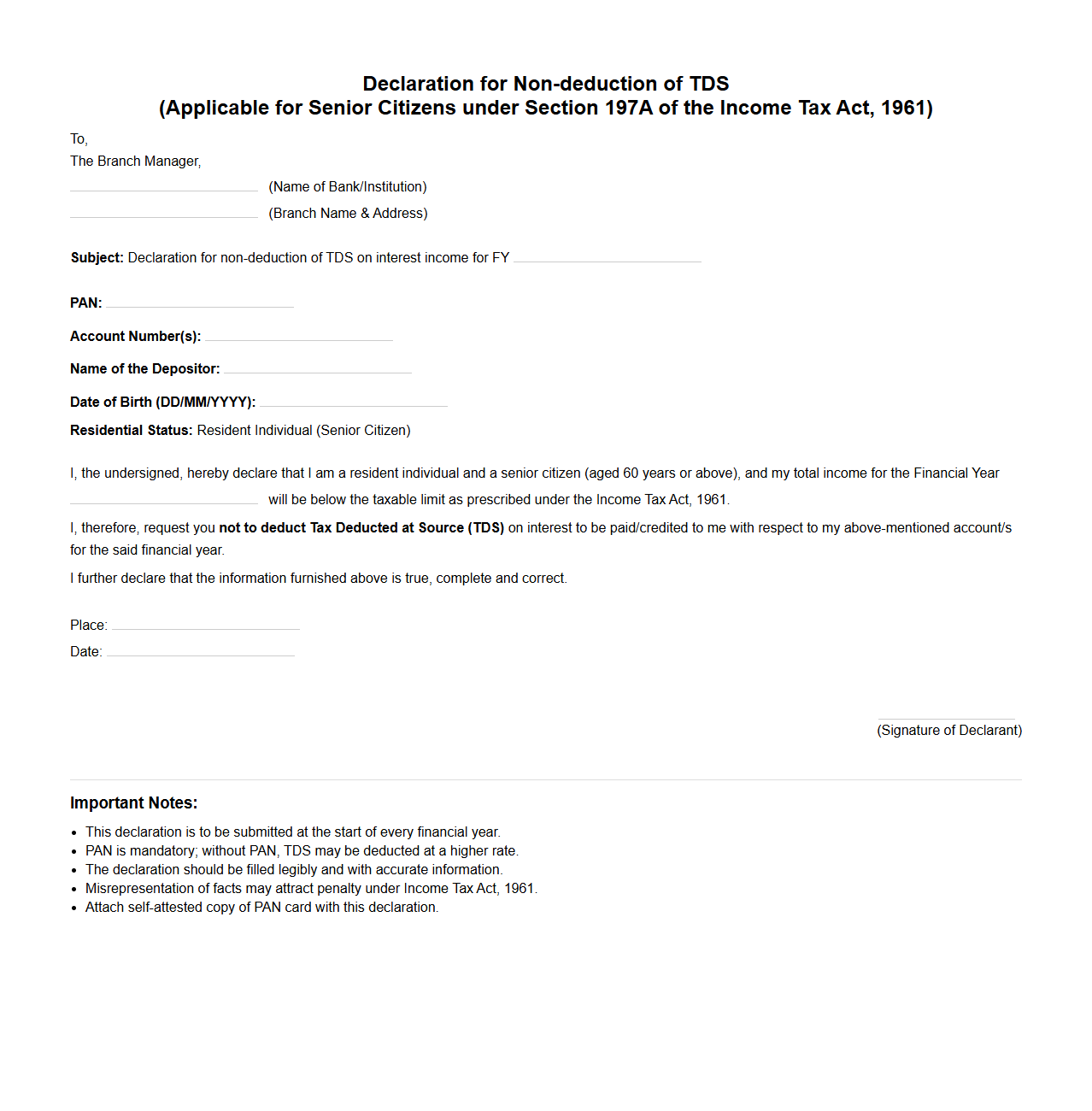
The
TDS Exemption Declaration Format for Senior Citizens is a prescribed document allowing individuals above a specified age to declare their eligibility for exemption from Tax Deducted at Source (TDS) on certain income types, such as interest earned on fixed deposits. This format typically includes details like name, age, account number, and a declaration affirming that the income is exempt under relevant tax provisions. Submitting this format to banks or financial institutions helps senior citizens avoid unnecessary tax deductions and claim their rightful exemption.
Self-Declaration Statement for Income below Taxable Limit Format
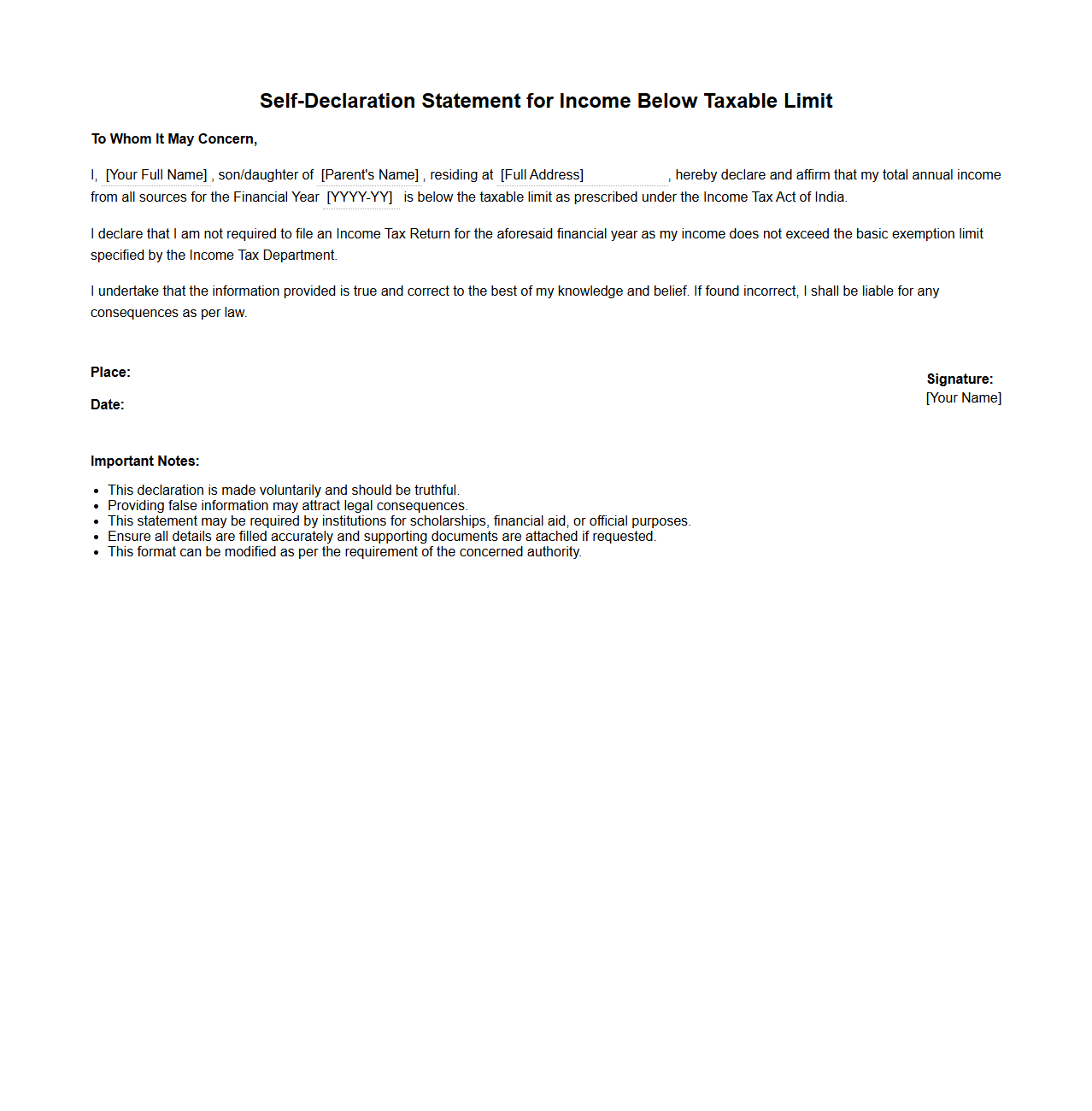
A
Self-Declaration Statement for Income below Taxable Limit Format document is a formal written declaration where an individual states that their annual income is below the government-defined taxable limit. This format typically includes personal details, income sources, and a statement confirming the income threshold is not exceeded, serving as proof for tax-exempt status. It is often required by employers, financial institutions, or government agencies to verify income eligibility for various benefits or exemptions.
Self-Declaration Format for Lower TDS under Section 197
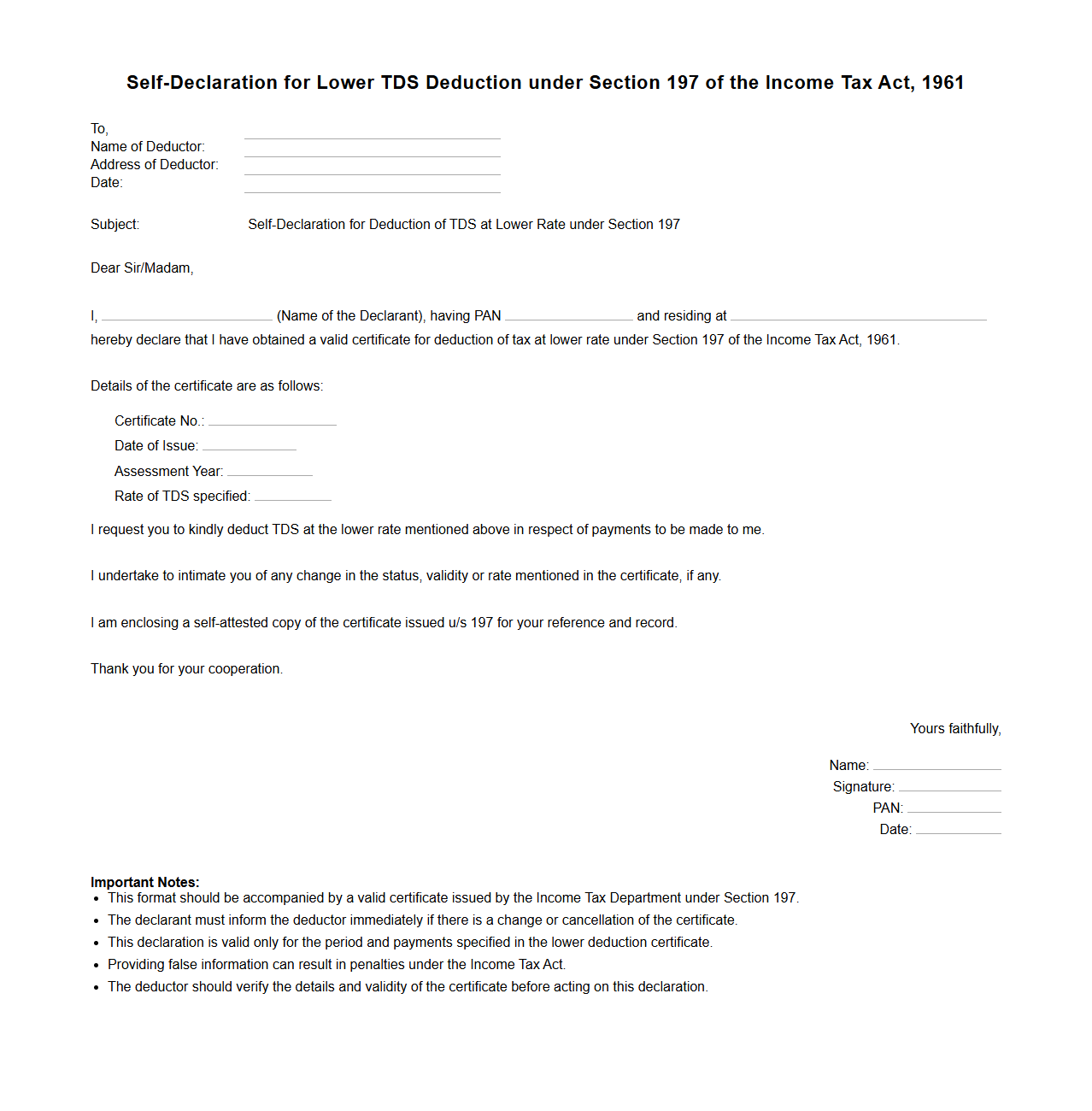
The
Self-Declaration Format for Lower TDS under Section 197 is a formal document submitted by taxpayers to request a reduction in Tax Deducted at Source (TDS) on specified payments. This declaration cites the taxpayer's estimated income and tax liability, allowing the deductor to apply a lower TDS rate as authorized by the Income Tax Department. It helps prevent excessive tax deductions, ensuring better cash flow management for taxpayers throughout the financial year.
Company Declaration Format for Lower/Nil TDS Deduction
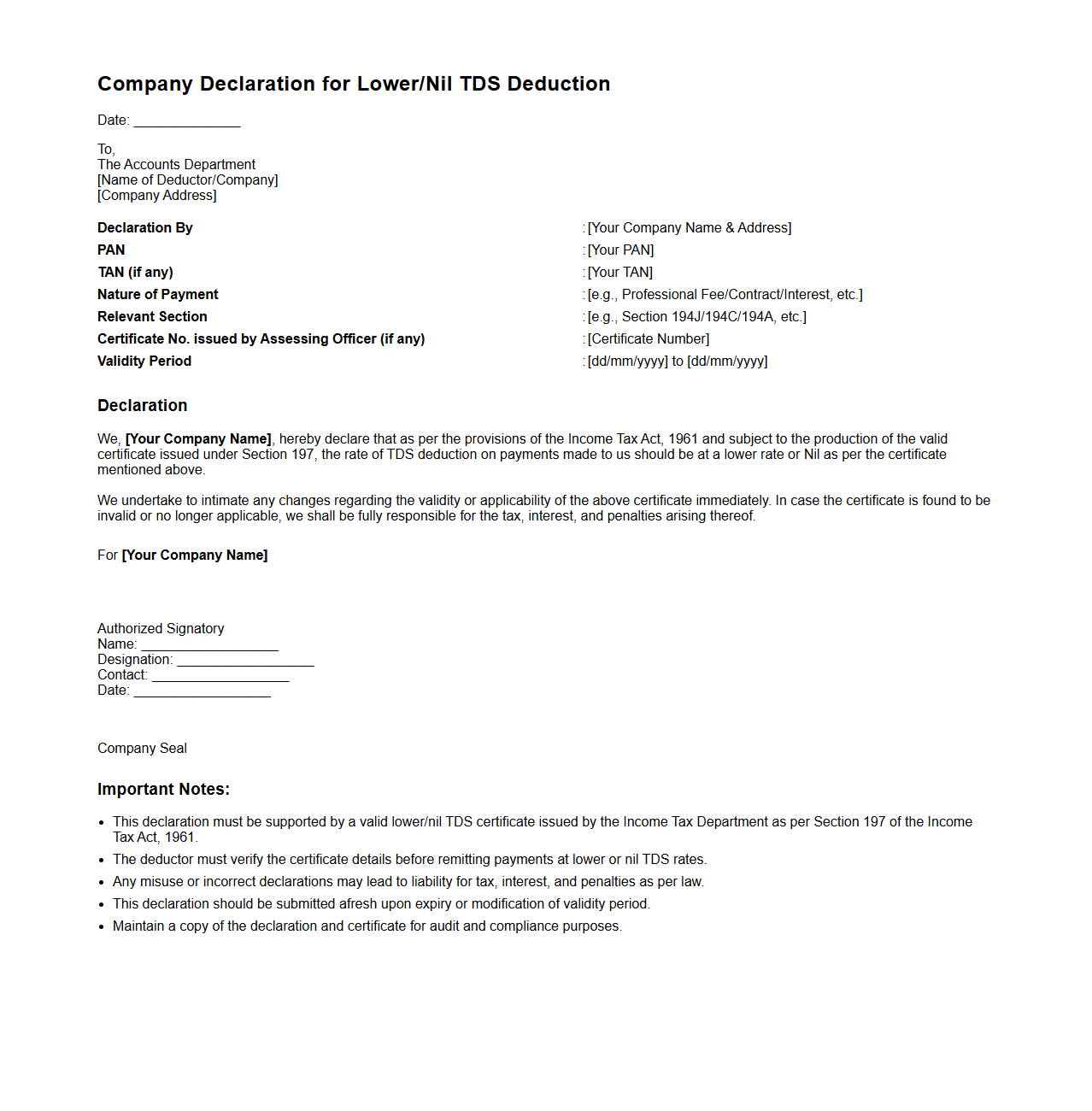
A
Company Declaration Format for Lower/Nil TDS Deduction document is a formal written statement submitted by a company to the tax authorities requesting a reduction or waiver of Tax Deducted at Source (TDS) on specified transactions. This declaration must include essential details such as the company's PAN, financial year, reasons for requesting lower or nil deduction, and relevant supporting documents to justify the claim. Proper submission of this format helps in compliance with income tax regulations and avoids unnecessary TDS deductions, thereby improving the company's cash flow management.
Self-Declaration Format by HUF for Lower TDS
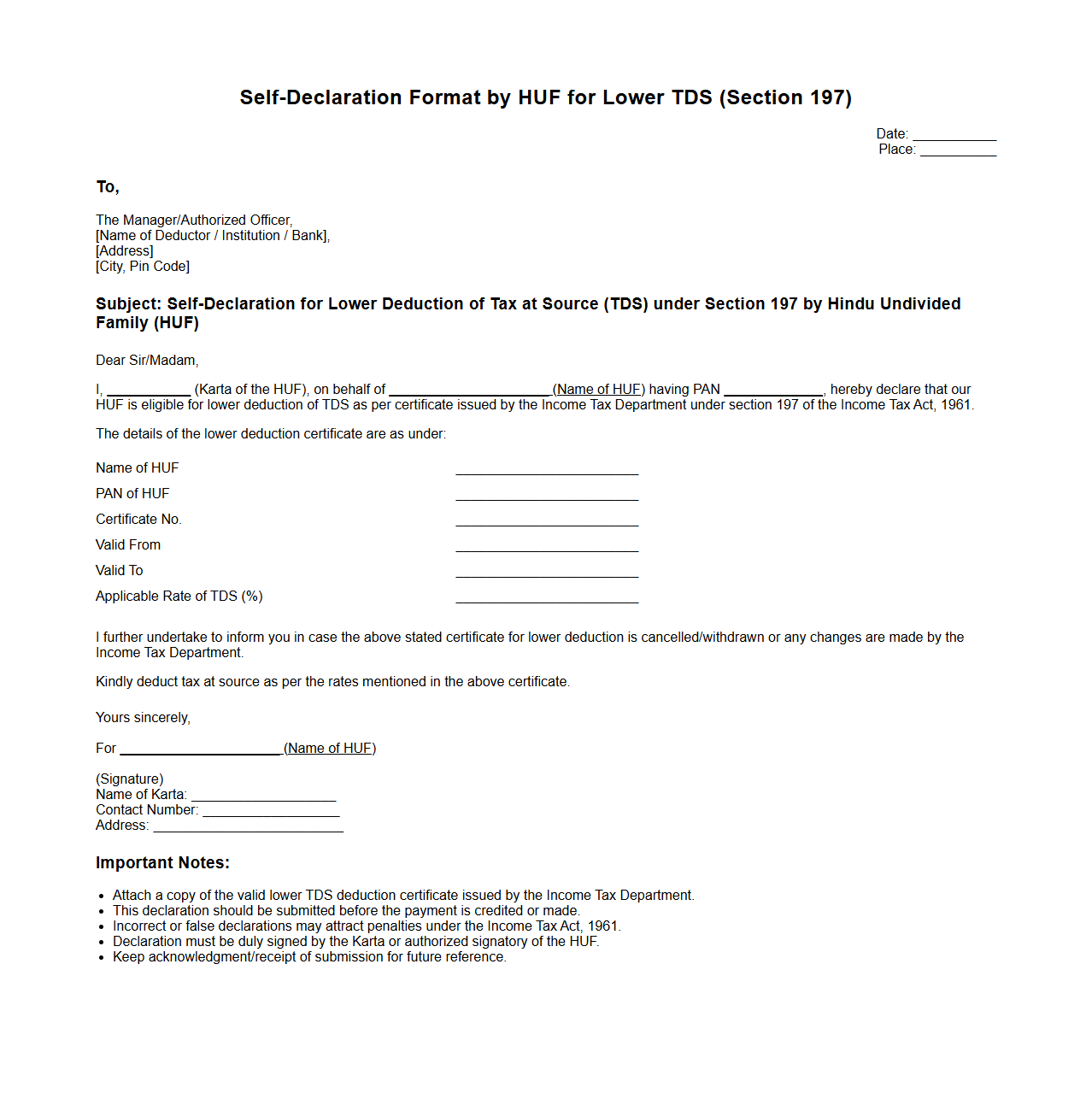
The
Self-Declaration Format by HUF for Lower TDS document is a formal declaration submitted by a Hindu Undivided Family to the income tax department to request a reduced rate of Tax Deducted at Source (TDS) on specified payments. This format includes essential details such as the HUF's PAN, estimated income, and declaration of eligibility for lower TDS rates under relevant tax provisions. Filing this self-declaration helps ensure correct TDS deduction and prevents excess withholding on transactions like interest payments, rent, or contractor bills.
Format of Self-Declaration for Non-Filing of TDS Returns
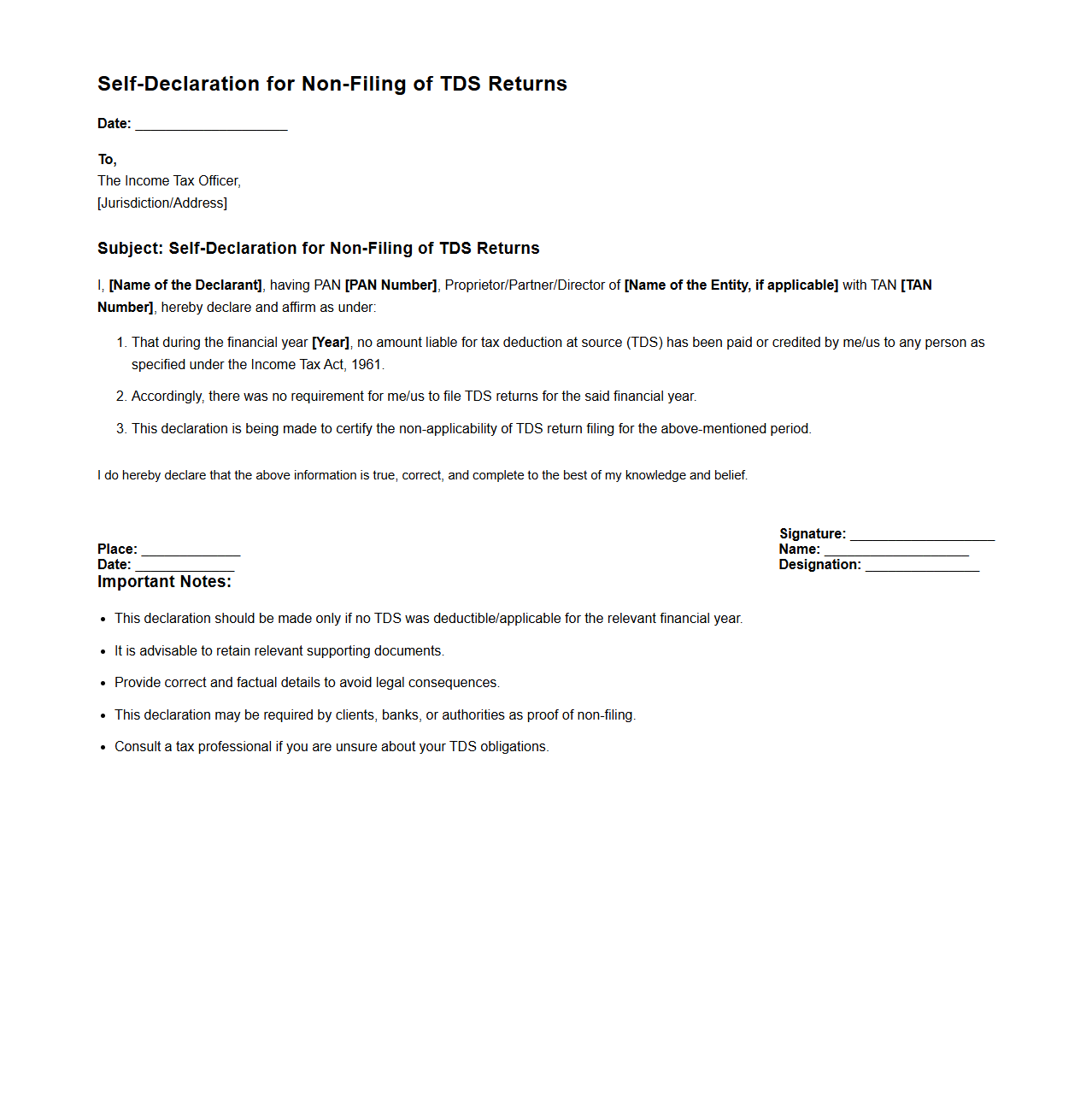
The
Format of Self-Declaration for Non-Filing of TDS Returns document serves as an official statement by deductors confirming that no Tax Deducted at Source (TDS) was deducted or no tax was payable for a specified period, thereby justifying the non-filing of TDS returns. This declaration typically includes details such as the deductor's name, PAN, period of non-deduction, and reasons for not filing, ensuring compliance with tax regulations and preventing penalties. Such formats are prescribed by tax authorities to maintain accurate records and streamline the verification process of non-filed returns.
What are the mandatory sections in a self-declaration form for lower/nil TDS?
The mandatory sections include details of the deductor and deductee, declaration of income for which TDS is lower or nil, and the reason for claiming lower or nil deduction. The form must also contain fields for the assessment year, section under which TDS is deducted, and the expected amount of income. These sections ensure clarity and compliance with tax regulations.
Which supporting documents must accompany the self-declaration format?
Supporting documents typically include proof of income such as salary slips, bank statements, or rent agreements to justify the lower or nil TDS claim. Additionally, a certificate from a chartered accountant may be required to validate the income estimation. These documents validate the claim and provide authenticity to the self-declaration.
What specific legal references should be cited in the self-declaration form for lower/nil TDS?
The form should cite the relevant Income Tax Act sections such as Section 197 for lower/nil deduction of TDS. References to the Central Board of Direct Taxes (CBDT) circulars and notifications may also be included for added legitimacy. Including these legal references ensures the form is compliant with existing tax laws.
How should digital signatures be incorporated in online self-declaration forms for TDS?
Digital signatures must be used to authenticate the identity of the declarant in online submissions. The signature should comply with the Information Technology Act, 2000, ensuring secure and legally valid electronic authentication. Incorporating digital signatures enhances the security and acceptance of the form.
What details regarding PAN and TAN must be included for validity in the form?
The form must mandatorily include the PAN (Permanent Account Number) of the deductee and the TAN (Tax Deduction Account Number) of the deductor for validity. These details help in the proper tracking and crediting of TDS to the correct accounts. Accurate PAN and TAN information ensure error-free processing of tax deductions.