The Format of EDI Document for Invoice follows a standardized structure to ensure seamless electronic data interchange between businesses. It typically includes segments for invoice number, date, billing details, line item descriptions, quantities, prices, and payment terms. Adhering to formats such as EDIFACT or X12 enables automated processing and accurate financial reconciliation.
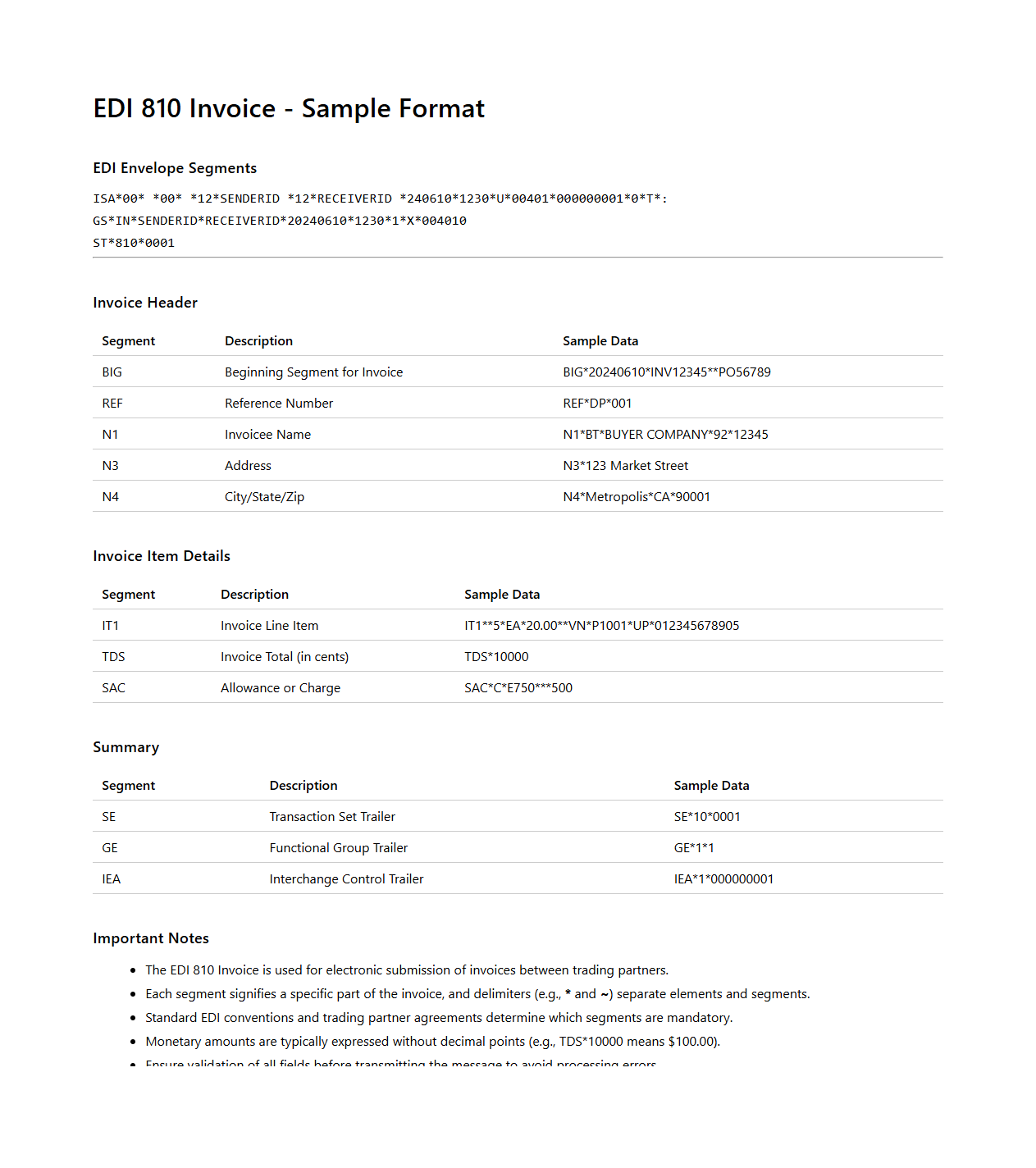
Standard EDI Invoice (EDI 810) Format
The
Standard EDI Invoice (EDI 810) format is an electronic document used to transmit billing information between trading partners efficiently and accurately. It replaces traditional paper invoices by standardizing data elements such as invoice number, date, purchase order references, product details, and payment terms. This format ensures faster processing, reduces errors, and supports automated accounts payable workflows within supply chain management.
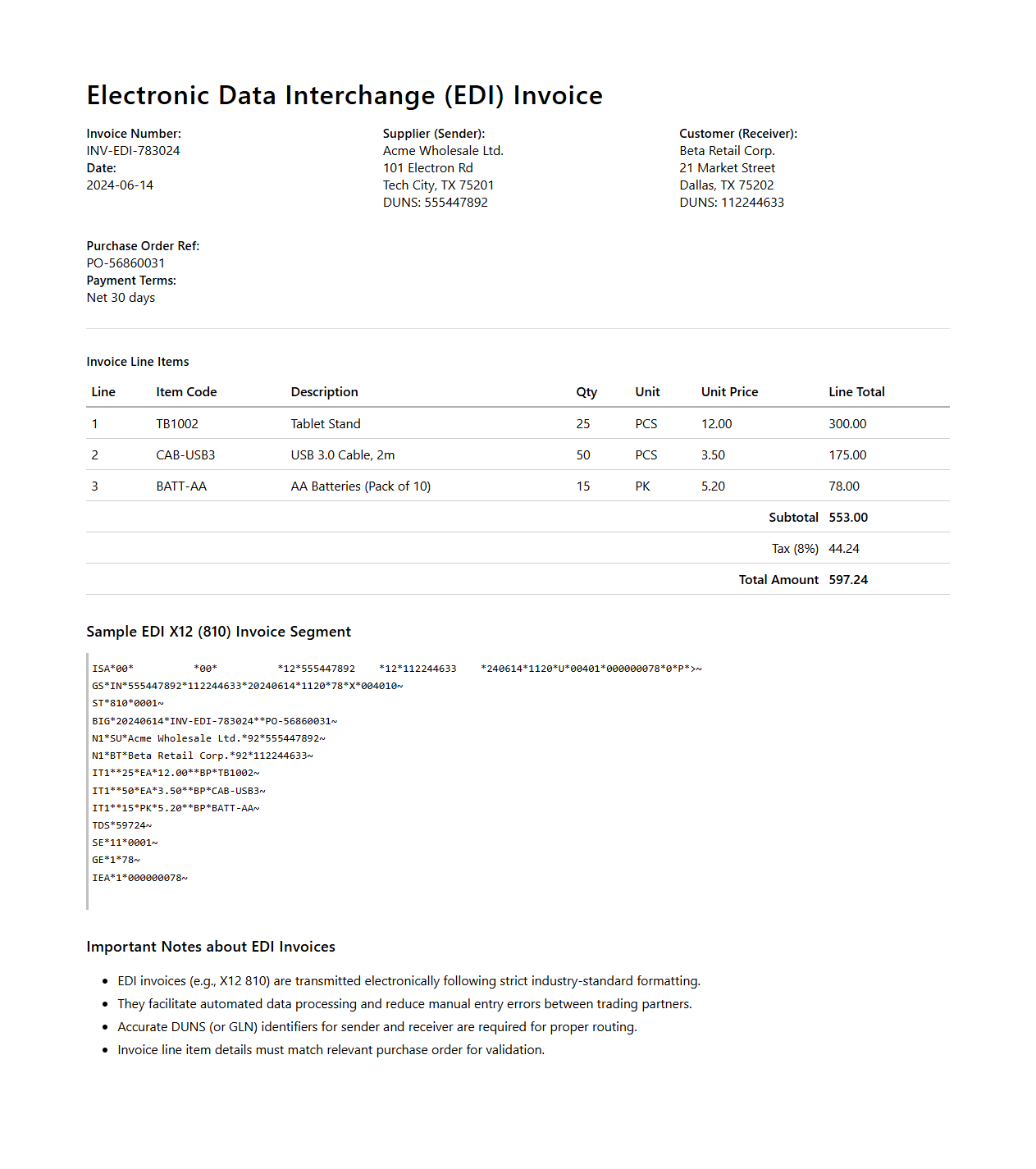
Electronic Data Interchange Invoice Format
The
Electronic Data Interchange (EDI) Invoice Format document is a standardized digital format used to electronically transmit invoicing information between businesses. It streamlines the billing process by allowing companies to exchange invoice data such as item details, quantities, prices, and payment terms in a structured and automated way. This format reduces errors, accelerates transaction times, and supports efficient accounts payable and receivable management.
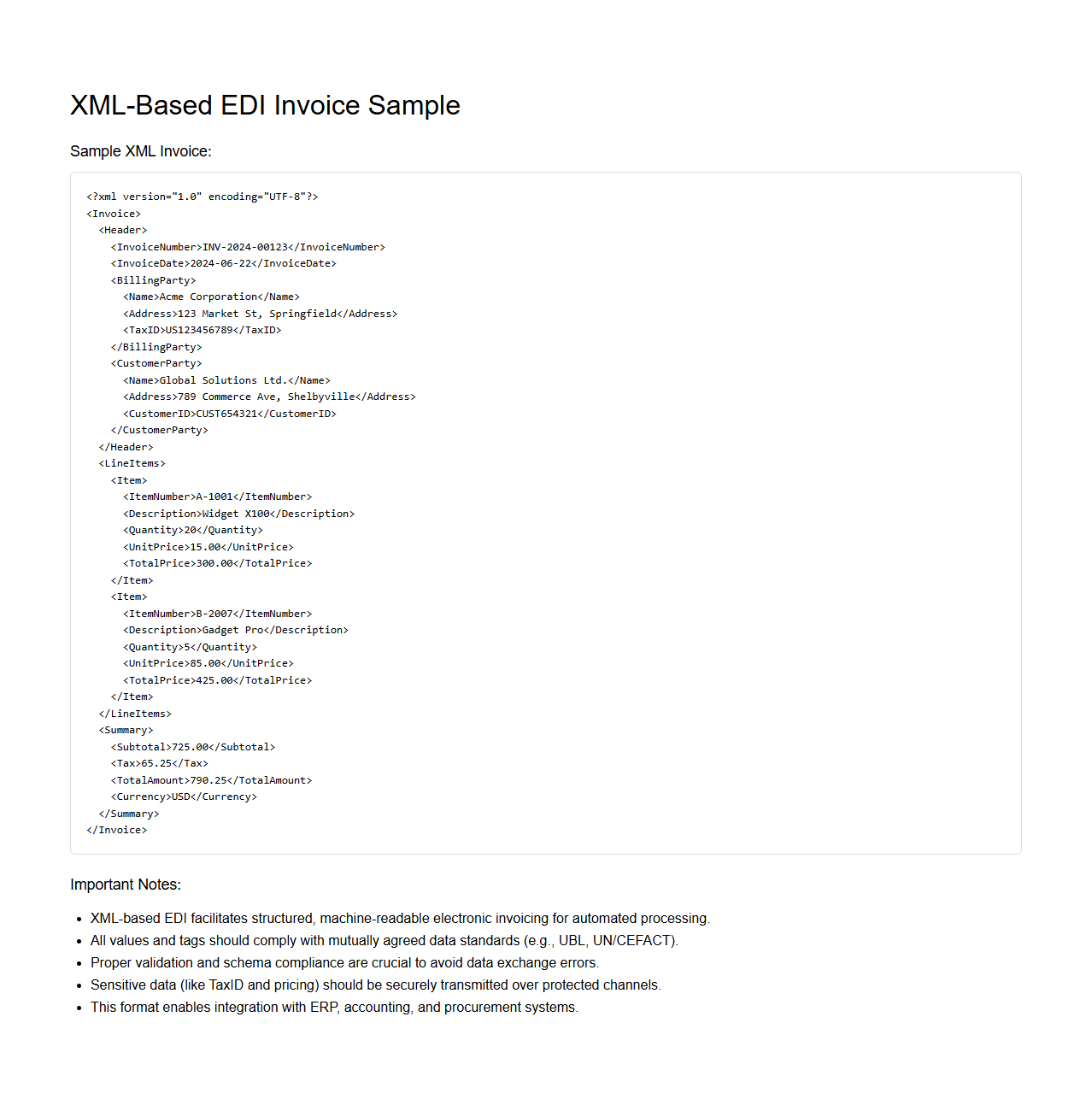
XML-Based EDI Invoice Format
An
XML-Based EDI Invoice Format document is a standardized electronic format for exchanging invoice data between businesses using Extensible Markup Language (XML). It enables seamless, automated processing of invoices by structuring data into hierarchies and tags that are machine-readable and interoperable across different systems. This format enhances accuracy, reduces processing time, and supports compliance with industry and regulatory requirements in electronic commerce.
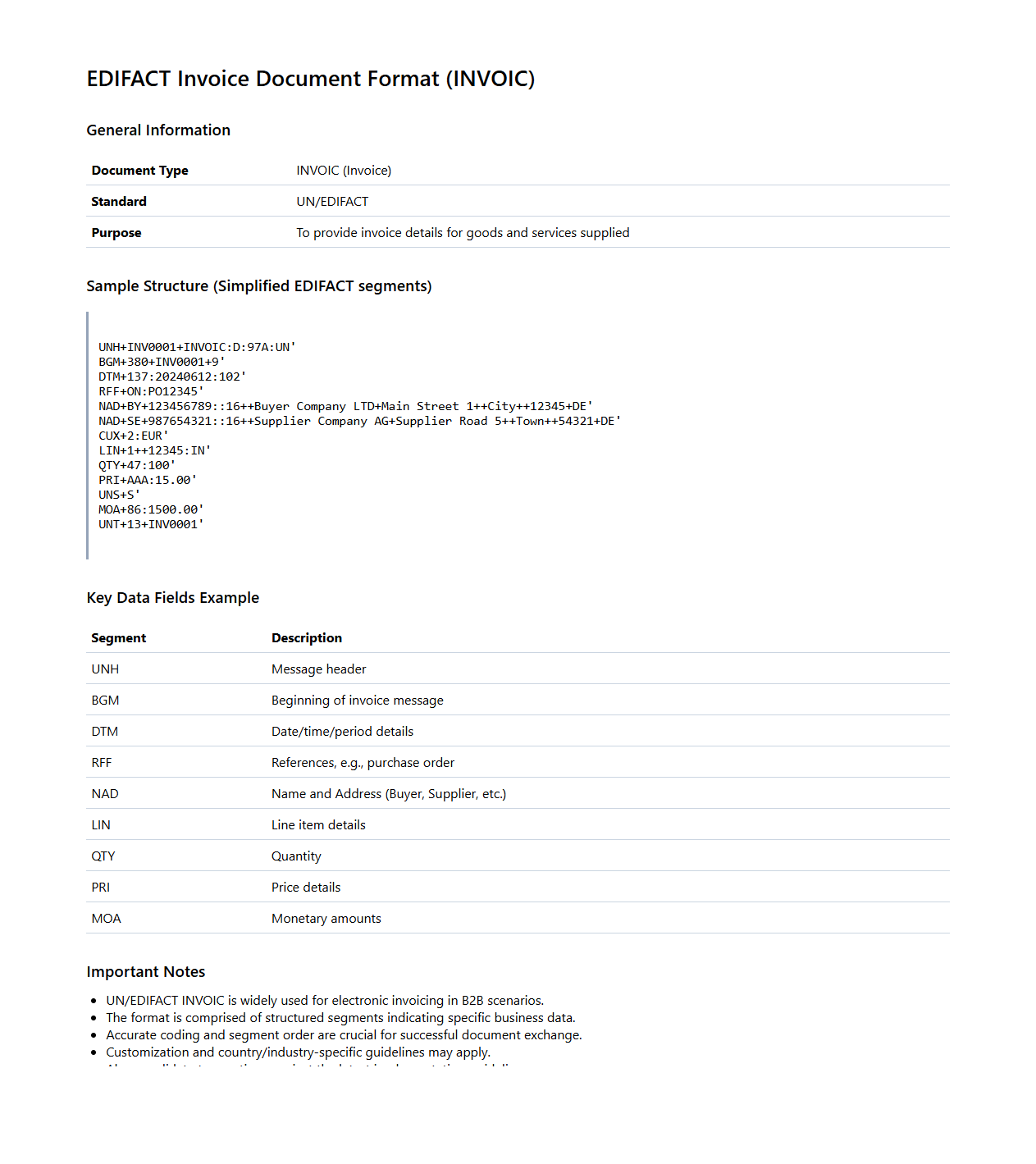
EDIFACT Invoice Document Format (INVOIC)
The
EDIFACT Invoice Document Format (INVOIC) is an international standard for electronic invoicing established by the United Nations. It facilitates the structured exchange of invoice data between trading partners, ensuring consistency and accuracy in billing processes across different industries and countries. By using a standardized format, INVOIC reduces errors, accelerates payment cycles, and supports automated processing in supply chain management.
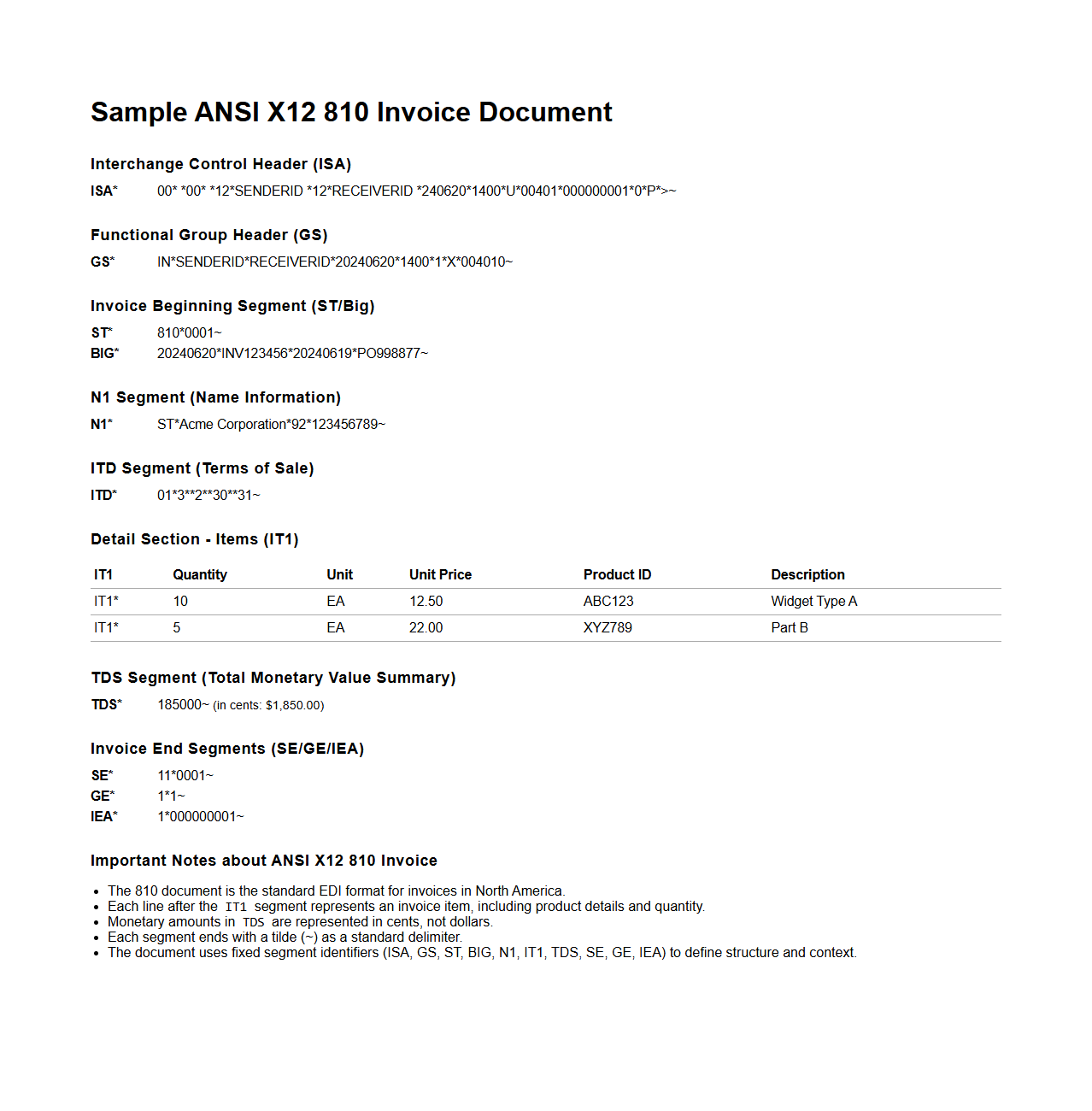
ANSI X12 810 Invoice Document Format
The
ANSI X12 810 Invoice Document Format is a standardized electronic data interchange (EDI) transaction set used to transmit detailed billing information between suppliers and buyers. It includes key elements such as invoice number, date, item descriptions, quantities, prices, and payment terms, ensuring consistent and accurate invoicing across diverse business systems. This format streamlines accounts payable processes, reduces errors, and enhances transaction efficiency in supply chain management.
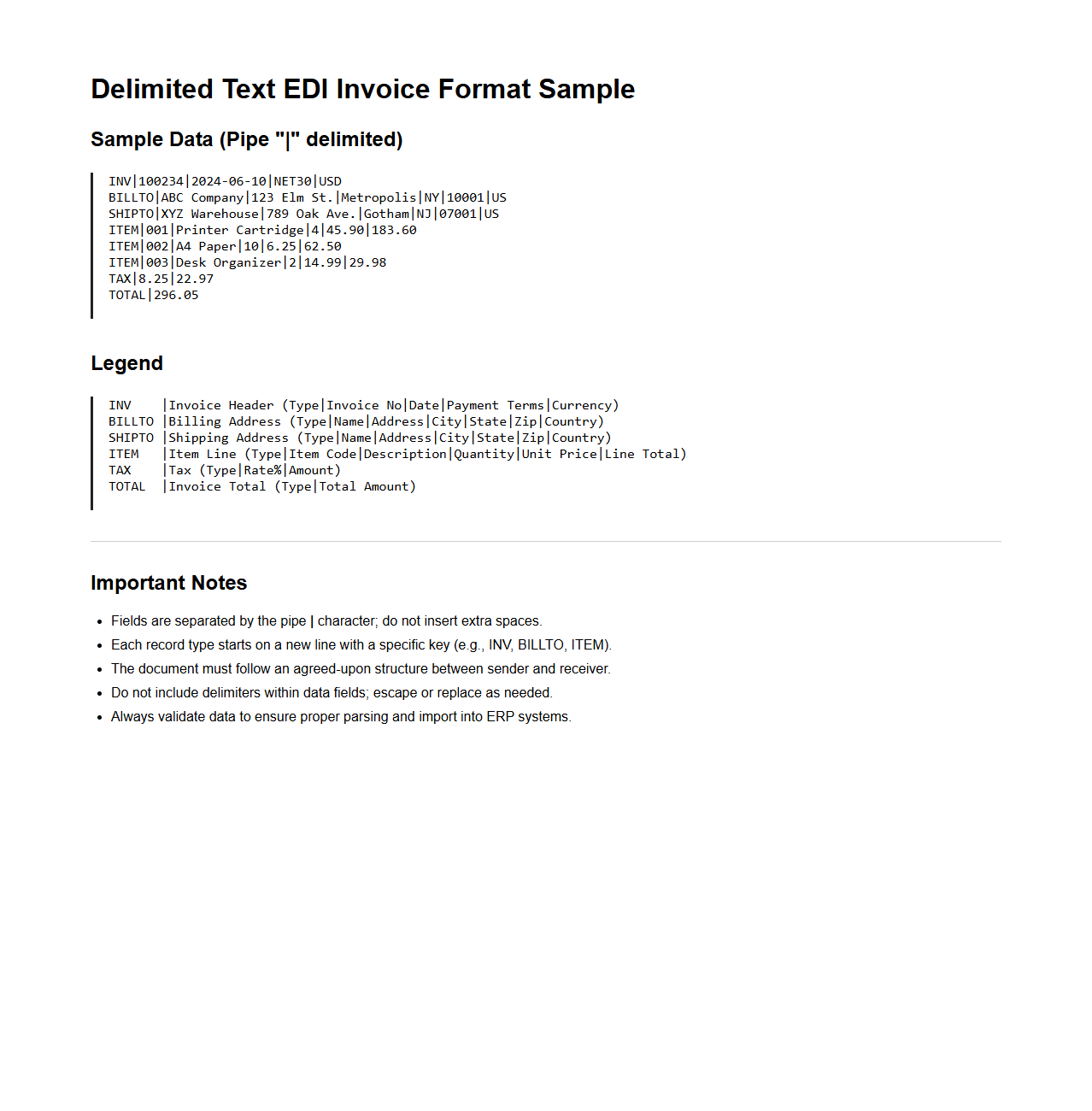
Delimited Text EDI Invoice Format
The
Delimited Text EDI Invoice Format document is a structured file used to electronically exchange invoice data between trading partners. It organizes information such as invoice number, date, item descriptions, quantities, prices, and totals into clearly separated fields using specific delimiters like commas or tabs. This format ensures accurate data parsing and integration into accounting or ERP systems, streamlining invoicing processes and reducing errors.
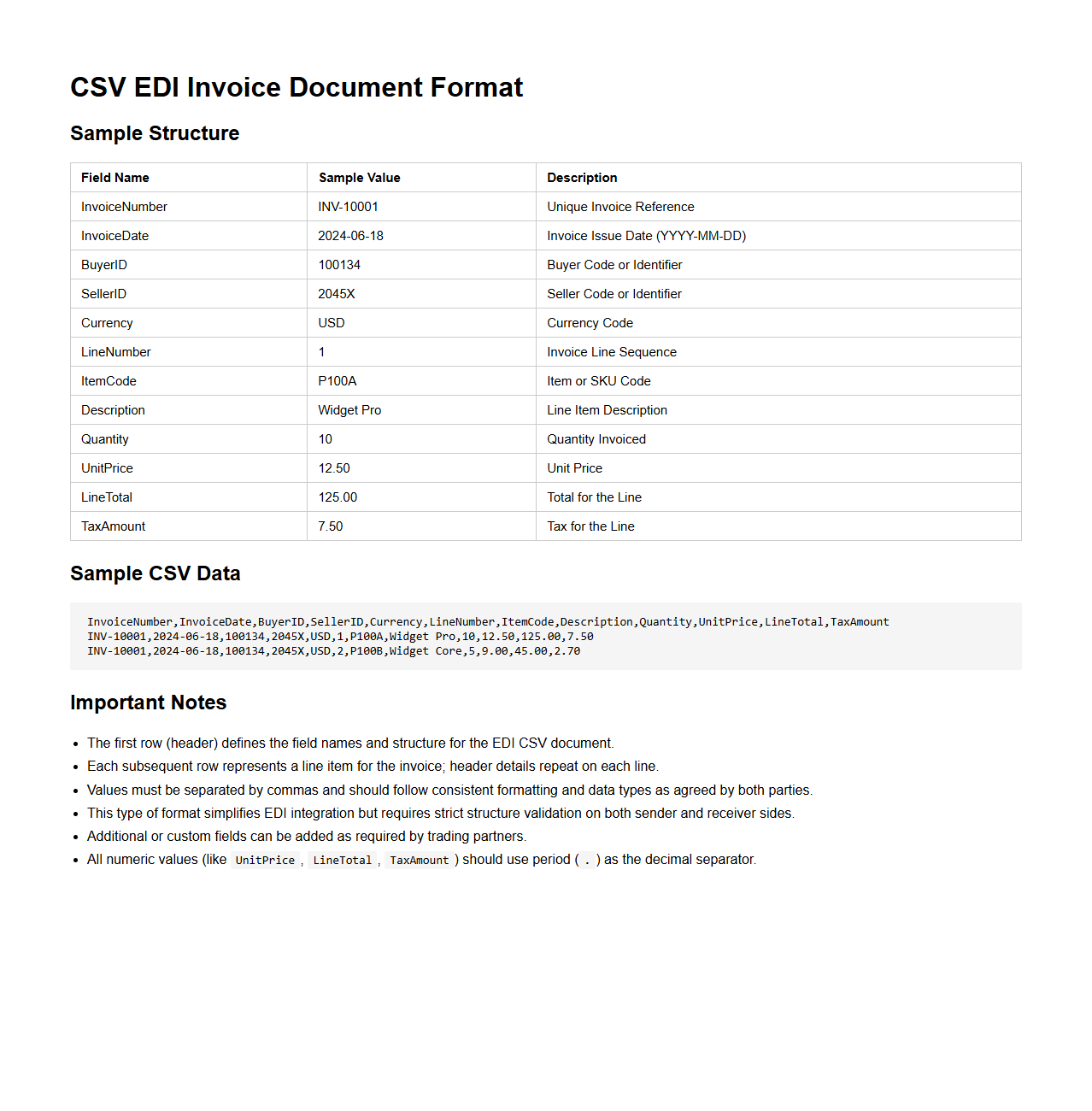
CSV EDI Invoice Document Format
The
CSV EDI Invoice Document Format is a standardized file format used to exchange electronic invoicing data between trading partners in a simple, structured manner. It utilizes comma-separated values (CSV) to organize invoice details such as invoice number, date, line items, quantities, and prices, enabling automated processing and reducing manual errors. This format supports efficient data integration with accounting and ERP systems, facilitating faster payment cycles and improved transaction accuracy.
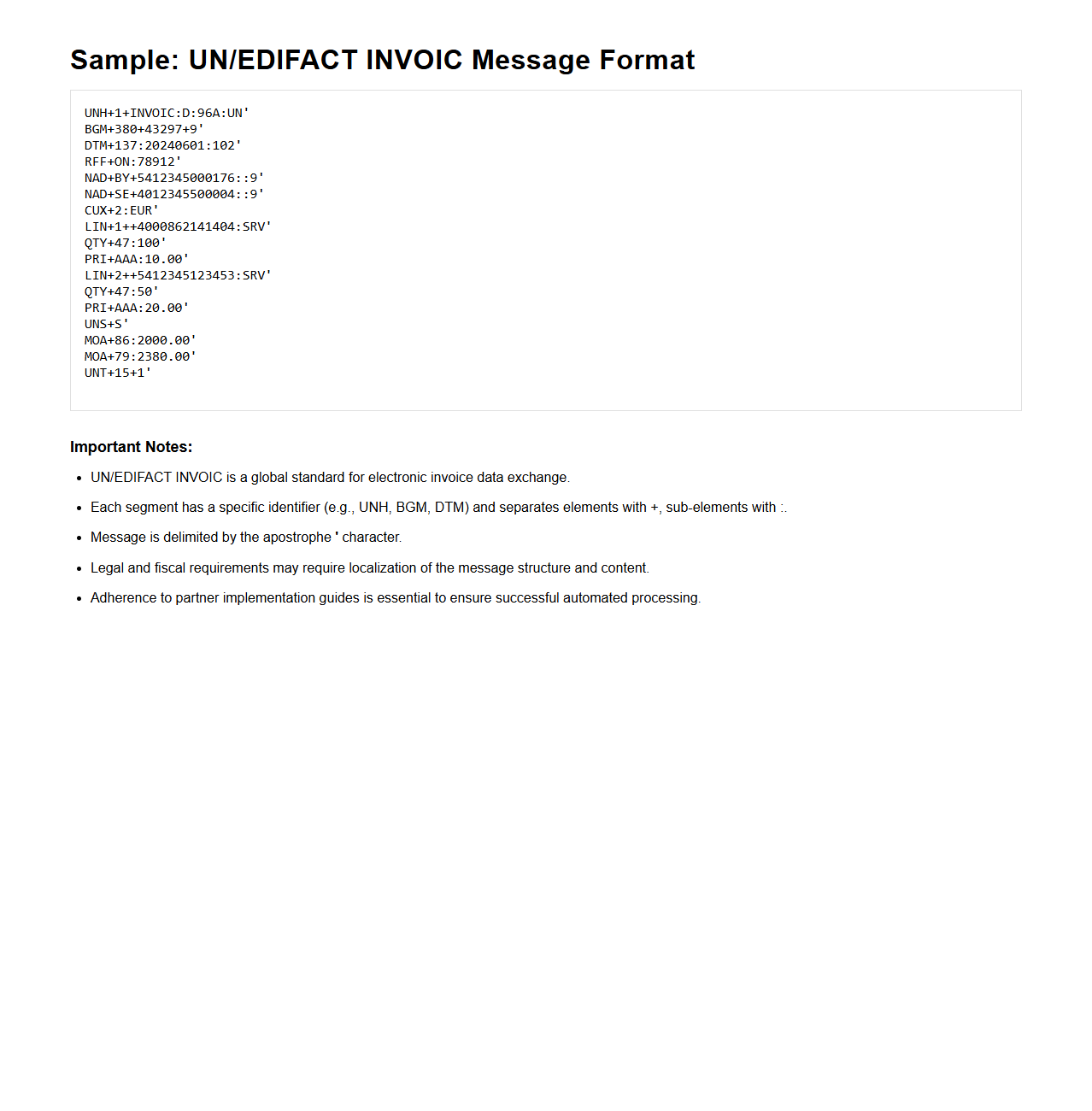
UN/EDIFACT INVOIC Message Format
The UN/EDIFACT INVOIC Message Format document is a standardized electronic format used for exchanging invoice information between businesses in a consistent and structured manner. It facilitates automated processing of invoices by defining specific data segments for details such as payment terms, item quantities, prices, and tax information, ensuring accuracy and efficiency. This format is widely adopted in international trade to streamline
electronic invoicing and reduce manual errors.
PDF EDI Invoice Document (Hybrid)
A
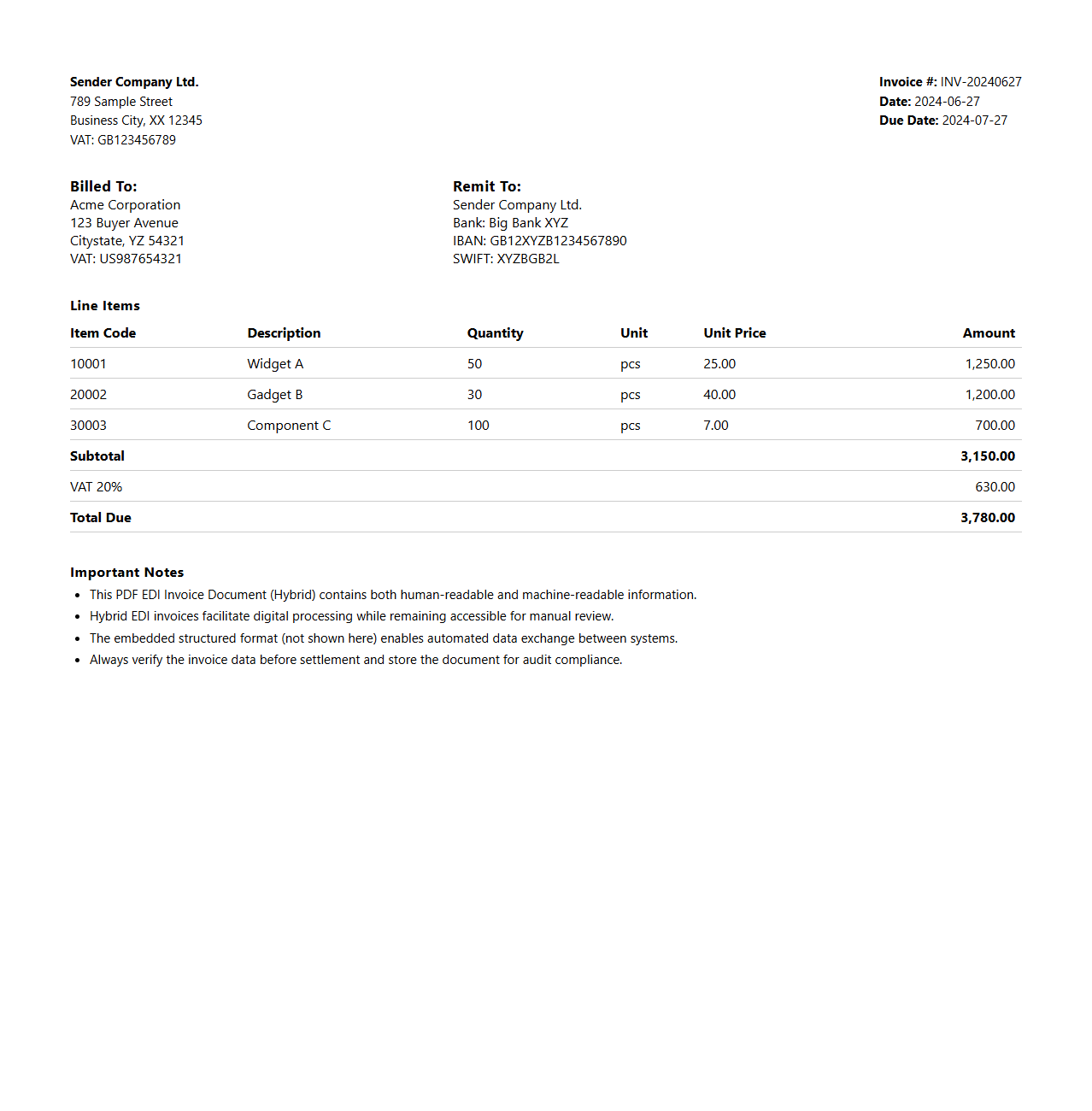
PDF EDI Invoice Document (Hybrid) combines the visual layout of a traditional PDF invoice with embedded structured EDI data, enabling both human readability and automated processing. This hybrid format streamlines invoice handling by allowing businesses to easily extract data for accounting systems while maintaining a clear, professional invoice presentation. It enhances efficiency in electronic invoicing by bridging the gap between paper-based and fully electronic document exchanges.
UBL (Universal Business Language) Invoice Format
The
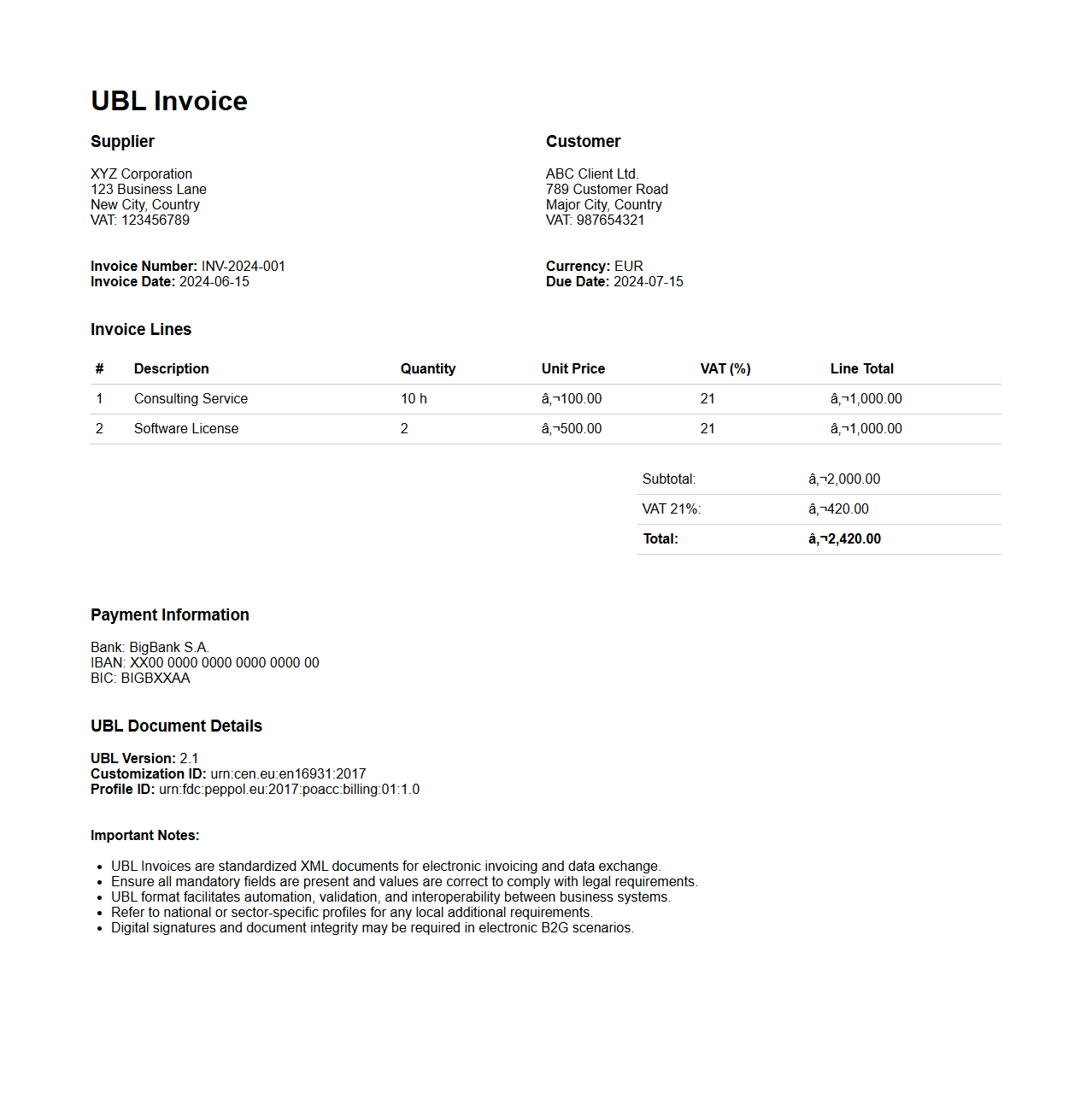
Universal Business Language (UBL) Invoice Format is an XML-based standard designed to streamline electronic invoicing by providing a consistent and interoperable structure for business documents. It facilitates automated processing and exchange of invoices between different systems and organizations, reducing errors and operational costs. UBL Invoice Format supports detailed invoice information, including supplier details, payment terms, tax data, and itemized product or service descriptions.
What are the mandatory segments in the EDI 810 invoice format?
The mandatory segments in the EDI 810 invoice format include the BIG segment, which contains invoice date and number details. The N1 segment identifies the billing and shipping parties involved. Additionally, the IT1 segment is required to detail line items for products or services on the invoice.
How is tax information represented in an EDI invoice document?
Tax information in an EDI invoice is primarily communicated through the TAX segment. This segment specifies the type, rate, and amount of tax applicable to the transaction. Proper use of TAX ensures compliance with legal and financial reporting standards.
Which code qualifiers specify payment terms in an EDI 810 invoice?
Payment terms are specified in the ITD segment within the EDI 810 invoice. This segment uses code qualifiers such as 01 for basic payment terms and 03 for specified discount percentages. The correct qualifiers help clarify payment deadlines and potential discounts.
How are multiple line items structured within the EDI invoice format?
Multiple line items in the EDI invoice are structured using repeated IT1 segments. Each IT1 segment represents a single line item, detailing product identification, quantity, and pricing. This structure enables clear and organized representation of all invoiced goods or services.
What segment identifies currency type in an EDI document for invoices?
The CUR segment identifies the currency type in EDI invoices. It specifies the currency code used for the transaction, such as USD for US dollars or EUR for euros. Including this segment ensures accurate financial interpretation across different regions.